
Latest news
Edge Computing
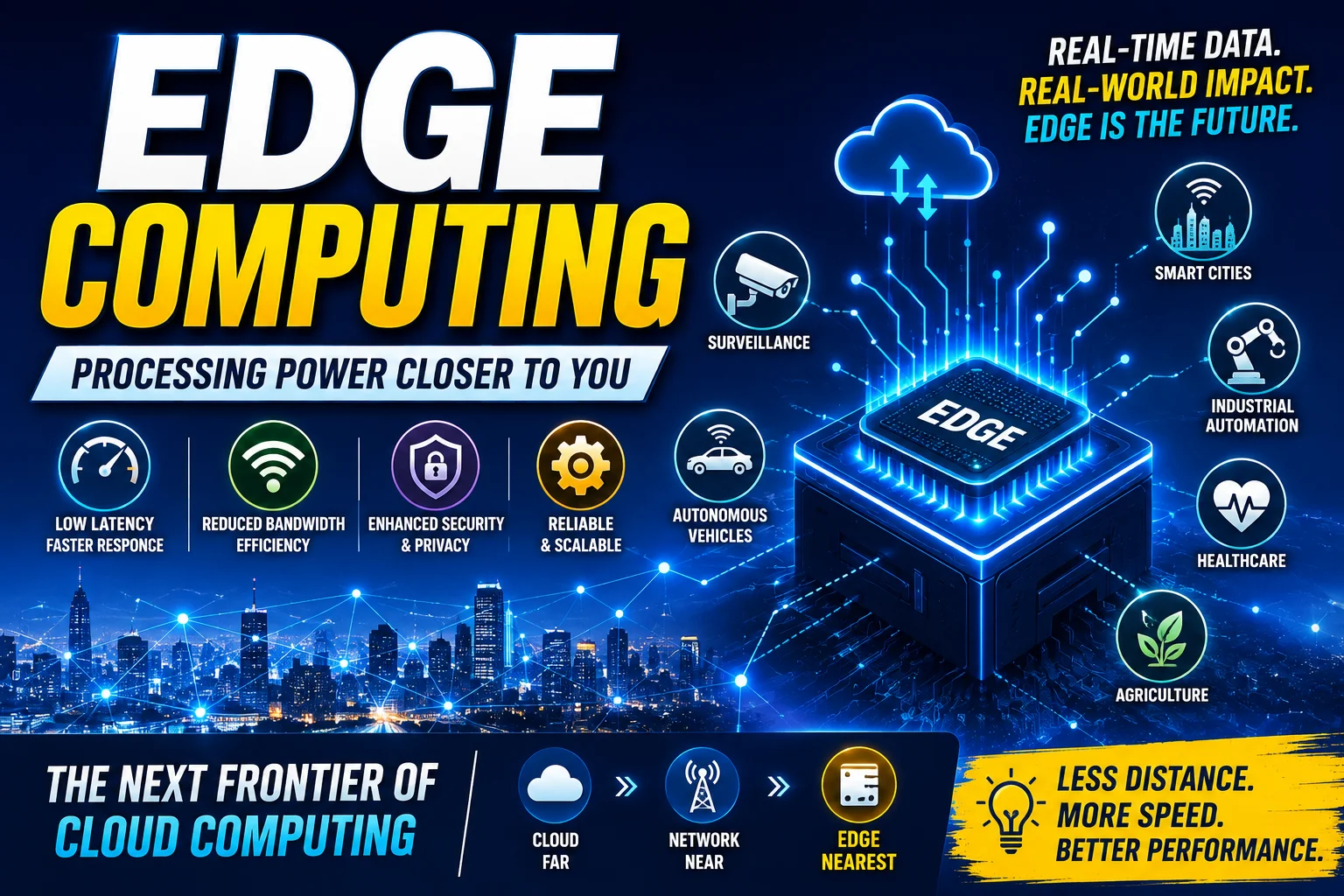
Edge Computing: Meaning, Benefits, Applications & Challenges
As digital technologies continue to evolve, the demand for faster data processing and real-time decision-making is increasing rapidly. Technologies such as Artificial Intelligence (AI), the Internet of Things (IoT), autonomous vehicles, and smart cities generate massive amounts of data every second. Processing all this data in distant cloud servers often leads to delays. To overcome this challenge, Edge Computing has emerged as a revolutionary technology that processes data closer to where it is generated.
What is Edge Computing?
Edge Computing is a distributed computing model in which data is processed and analyzed near the source of data generation, known as the "edge" of the network, instead of sending it to centralized cloud data centres.
By reducing the distance that data needs to travel, Edge Computing enables faster processing, lower latency, and improved efficiency.
Why is Edge Computing Important?
With billions of connected devices generating continuous data, relying solely on cloud computing can lead to network congestion and delays. Edge Computing addresses these issues by processing critical information locally, making it ideal for applications requiring real-time responses.
It is particularly useful in autonomous vehicles, industrial automation, healthcare, smart cities, and defence systems.
Applications of Edge Computing
Smart Cities
Edge Computing helps manage traffic signals, surveillance systems, waste management, and energy distribution by enabling instant data analysis and faster decision-making.
Healthcare
Wearable devices and remote patient monitoring systems use Edge Computing to analyze health data in real time, allowing quicker diagnosis and emergency response.
Industrial Automation
Factories use Edge Computing to monitor machinery, predict equipment failures, and improve production efficiency while reducing downtime.
Autonomous Vehicles
Self-driving cars process sensor data instantly to detect obstacles, make navigation decisions, and ensure passenger safety without depending entirely on cloud servers.
Agriculture
Smart farming technologies use Edge Computing for soil monitoring, irrigation control, weather analysis, and crop health assessment, improving agricultural productivity.
Benefits of Edge Computing
-
Faster data processing with minimal latency.
-
Reduced dependence on cloud networks.
-
Lower bandwidth consumption.
-
Improved data privacy and security.
-
Enhanced reliability even with limited internet connectivity.
-
Better support for AI, IoT, and 5G technologies.
These advantages make Edge Computing a key technology for future digital infrastructure.
Challenges
Despite its benefits, Edge Computing also faces certain challenges:
-
High infrastructure and deployment costs.
-
Cybersecurity risks across multiple edge devices.
-
Complex network management.
-
Limited computing power compared to large cloud data centres.
-
Need for skilled professionals to manage edge infrastructure.
Addressing these challenges will be essential for widespread adoption.
Conclusion
Edge Computing is transforming the way data is processed by bringing computing power closer to users and connected devices. It enables faster decision-making, improves efficiency, and supports emerging technologies such as AI, IoT, and 5G. As India advances towards a digital economy and smart infrastructure, Edge Computing will play a crucial role in driving innovation across industries.