Organisation
Delimitation Issue in Recent Times in India
Delimitation Issue in Recent Times in India: Why Is It Important?
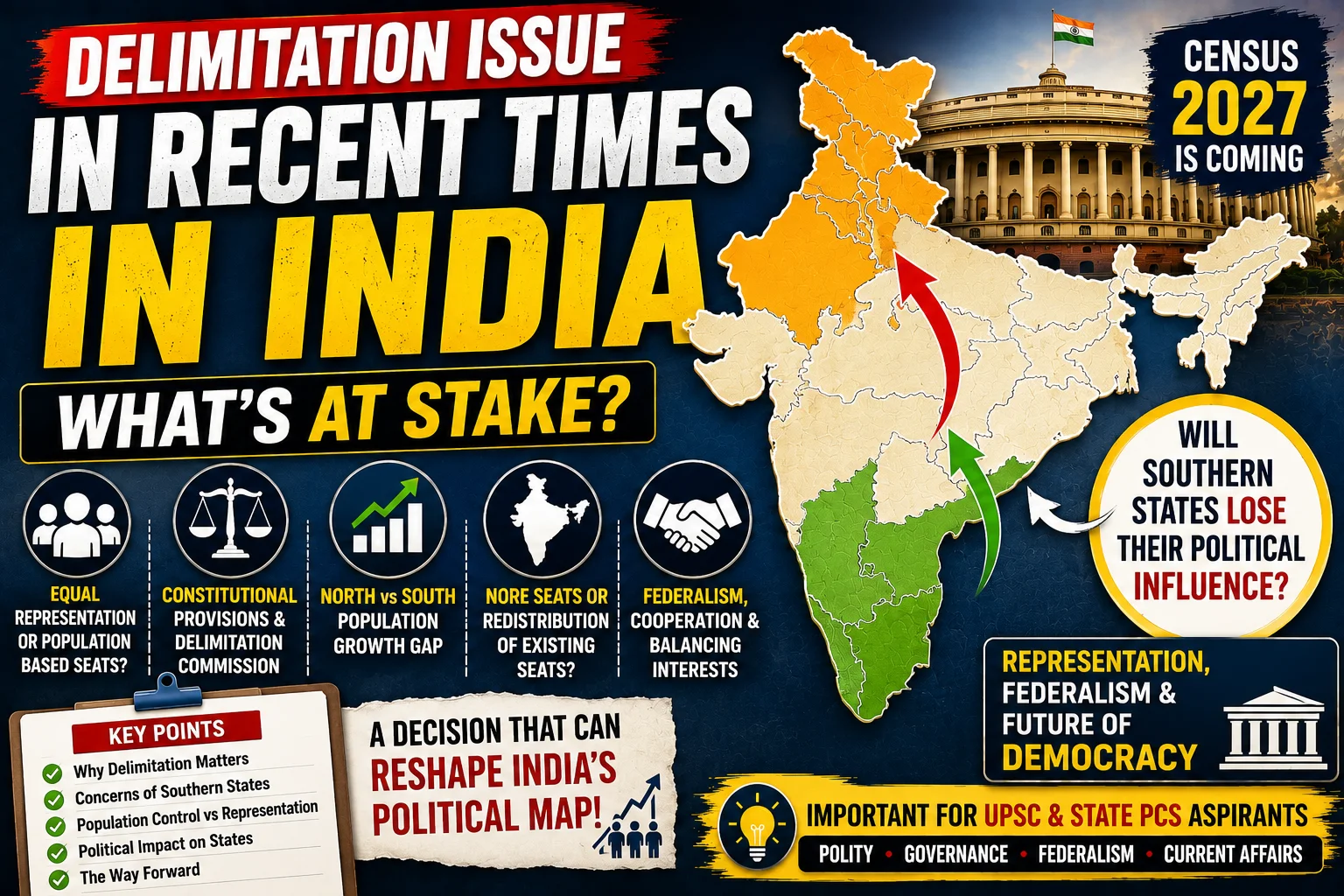
Delimitation has become an important national issue in India, especially with the upcoming Census 2027 and recent discussions about the future strength of the Lok Sabha. The issue is closely connected with population, political representation, federalism and the balance between different states.
What Is Delimitation?
Delimitation means the readjustment of boundaries and seats of electoral constituencies based mainly on population. Its purpose is to ensure that representation in Parliament and State Assemblies remains broadly aligned with population distribution.
The Constitution provides for delimitation of constituencies, and the process is generally carried out through a Delimitation Commission. However, India has periodically frozen the allocation of Lok Sabha seats among states to encourage states to implement population-control measures.
The present allocation of Lok Sabha seats is largely based on the 1971 Census, while constituency boundaries have undergone later adjustments. The constitutional freeze on readjusting the allocation of seats among states was extended until the first Census after 2026. This is why the upcoming Census has made delimitation a major issue.
Why Has the Issue Become Important Now?
The issue has gained fresh attention because Census 2027 is currently underway. The first phase, involving house-listing and housing information, is being conducted during 2026, while population enumeration is scheduled for 2027. The government has also decided to include caste enumeration in the second phase.
Once updated population data becomes available, questions will arise regarding how parliamentary constituencies should be redistributed.
This creates a major political and federal debate.
Why Are Southern States Concerned?
States such as Tamil Nadu, Kerala, Karnataka and Andhra Pradesh have historically performed better in controlling population growth. Their populations have grown more slowly compared with several northern and central states.
The concern is that if representation is redistributed strictly according to population, states with larger populations could receive a greater number of Lok Sabha seats.
Southern states therefore fear that their relative political influence could decline despite their success in areas such as population stabilisation, health and human development.
The Union Government, however, has argued that the proposed approach would not disadvantage southern states. In a 2026 parliamentary discussion, the government stated that under a model increasing the Lok Sabha's strength from 543 to 816 seats, the number of seats from southern states could rise from 129 to 195 while their overall share would remain around 24%.
Why Is Delimitation Important for Federalism?
Delimitation is not simply about drawing constituency boundaries. It can influence the political balance between states.
A state receiving more Lok Sabha seats would potentially have greater representation in Parliament. This makes delimitation an important issue for India's federal structure.
At the same time, representation based on population follows the democratic principle of “one person, one vote”. Therefore, India has to balance two competing objectives:
- Equal representation based on population
- Recognition of states' efforts toward population stabilisation
What Should Be the Way Forward?
The delimitation process needs to be transparent, constitutionally sound and acceptable to all states. Political consultation between the Union and states will be important.
The objective should be to ensure that every citizen receives fair political representation without creating a perception that states which successfully controlled population growth are being penalised.
The delimitation debate represents a larger discussion about democracy, representation, population policy and cooperative federalism.
For UPSC and State PCS aspirants, this topic is highly relevant because it connects Indian Polity, Constitution, Federalism, Census, Elections and Demography.
Grace IAS Academy – Civil Services Preparation
For students searching for Top IAS Coaching in Chandigarh, Grace IAS Academy focuses on connecting current affairs with the static UPSC syllabus.
Aspirants looking for Best IAS Coaching in Chandigarh, Top UPSC Coaching in Chandigarh or Best UPSC Coaching in Chandigarh can benefit from a structured approach involving conceptual learning, current affairs, Prelims practice and Mains answer writing.
For State Civil Services preparation, Top Civil Services Coaching in Chandigarh, Best HCS Coaching in Chandigarh and Top HCS Coaching in Chandigarh are important search terms for aspirants looking for focused guidance.
Students preparing for Punjab PCS can also explore Best PCS Coaching in Chandigarh, with an examination-oriented approach combining syllabus coverage, practice and mentorship.