Organisation
Mecca Joint Defence Agreement
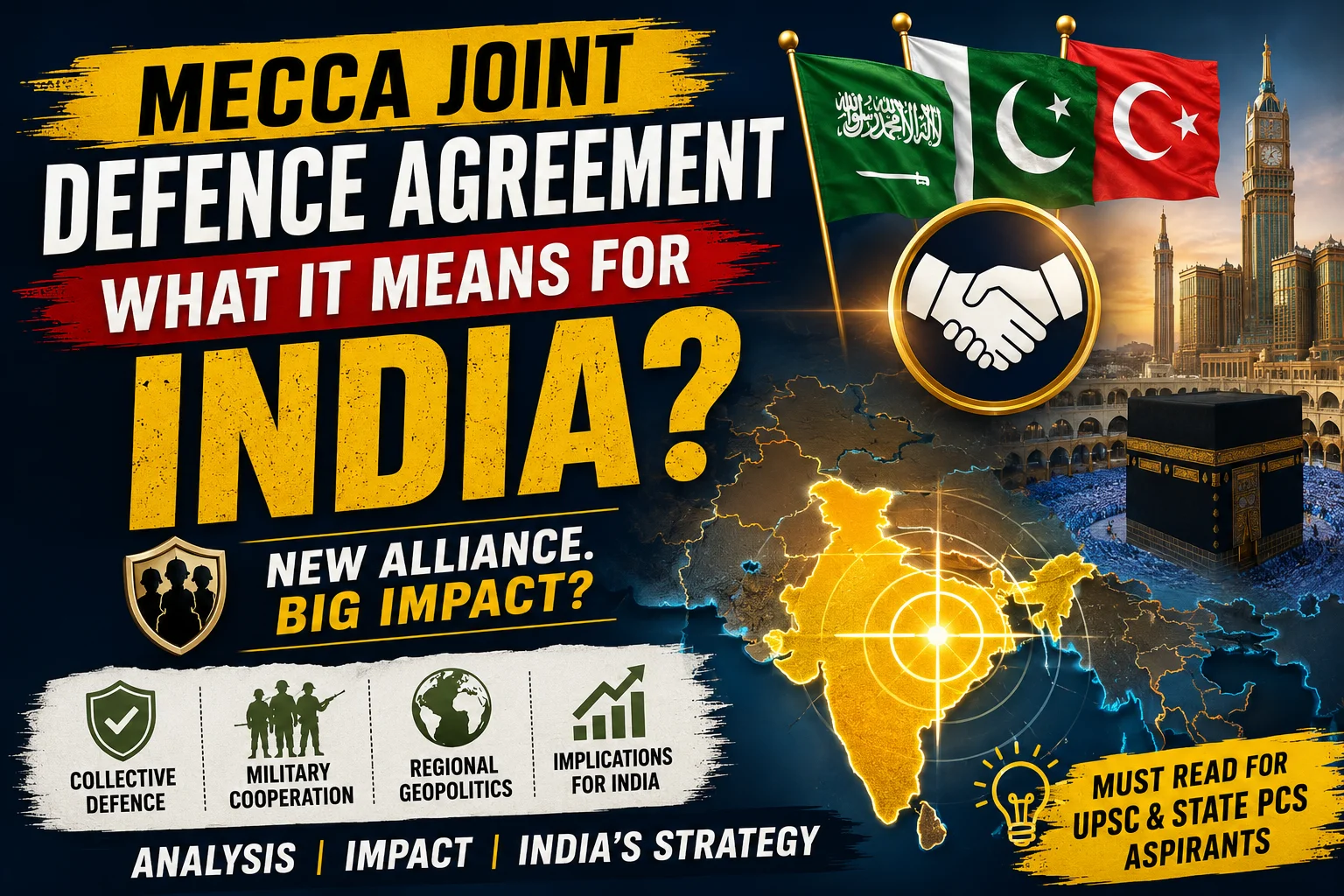
Mecca Joint Defence Agreement: What Does It Mean for India?
The Mecca Joint Defence Agreement, signed by Saudi Arabia, Türkiye and Pakistan on 7 August 2026, has attracted considerable attention because it could influence the evolving security environment of West Asia and South Asia. The agreement focuses on collective defence and closer military cooperation at a time when tensions and conflicts in the region are affecting energy supplies, maritime routes and regional stability.
For India, the development is particularly important because Pakistan is one of the three participating countries. However, the agreement should be viewed as a changing regional strategic arrangement rather than automatically assuming that it is directed against India.
What Is the Mecca Joint Defence Agreement?
The agreement establishes a framework for stronger security and defence cooperation among Saudi Arabia, Türkiye and Pakistan. One of its most significant provisions is that an armed attack against one member would be considered an attack against all three members. This principle has drawn comparisons with NATO's collective-defence approach, although the Mecca agreement does not necessarily have the same institutional structure or clearly defined military obligations.
The countries have also indicated plans for closer military coordination, including exercises and cooperation in areas such as unmanned systems, electronic warfare, artificial intelligence and defence technology.
Why Has This Agreement Emerged?
West Asia is experiencing a rapidly changing security environment. Conflicts, missile threats, attacks on infrastructure and uncertainty around major regional powers have encouraged countries in the region to explore stronger security partnerships.
The agreement also reflects the growing interest of regional countries in developing their own mechanisms for security and deterrence instead of depending entirely on external powers.
For Saudi Arabia, stronger defence partnerships can support its security interests and defence capabilities. Türkiye brings considerable military and defence-industrial capacity, while Pakistan contributes significant military experience and strategic capabilities.
What Could Be the Impact on India?
The immediate impact on India should not be exaggerated. The agreement is officially presented as a defensive and cooperative arrangement, and its publicly available details do not establish a specific military commitment against India.
Nevertheless, India's strategic planners will closely observe the strengthening of ties between Pakistan, Türkiye and Saudi Arabia.
Pakistan's participation is particularly relevant because India already has differences with Pakistan on several security and geopolitical issues. A stronger Pakistani relationship with major regional powers could potentially increase Islamabad's diplomatic and strategic options.
At the same time, India has substantial interests in Saudi Arabia and the wider Gulf region. These include energy security, trade, investment, connectivity, maritime security and the welfare of the Indian diaspora.
India's Strategic Response
India's best response is likely to be active diplomacy rather than overreaction.
New Delhi can strengthen its relationships with Gulf countries, deepen defence and maritime-security cooperation, maintain diversified energy partnerships and continue engagement with all major regional players.
India should also closely monitor developments involving the Arabian Sea, Red Sea, Persian Gulf and wider Indian Ocean Region, as instability in these areas can have direct consequences for India's trade and energy security.
Why Is It Important for Civil Services Aspirants?
The Mecca Joint Defence Agreement is an excellent example of how a current event can be connected with static topics such as:
- India's Foreign Policy
- International Relations
- West Asian Geopolitics
- Maritime Security
- Energy Security
- Strategic Autonomy
- India–Gulf Relations
- India–Pakistan Relations
For UPSC and State Civil Services aspirants, the focus should not be on memorising the agreement alone. The important question is how changing regional alliances can influence India's strategic interests.
Grace IAS Academy: Turning Current Affairs into Exam Preparation
At Grace IAS Academy, Current Affairs preparation is connected with the wider Civil Services syllabus so that aspirants learn to understand an issue from multiple dimensions. Such an approach can help students develop stronger analytical skills for Prelims, Mains and Interview.
For aspirants searching for Top IAS Coaching in Chandigarh, Best IAS Coaching in Chandigarh, Top UPSC Coaching in Chandigarh, Best UPSC Coaching in Chandigarh, Top Civil Services Coaching in Chandigarh, Best HCS Coaching in Chandigarh, Top HCS Coaching in Chandigarh, or Best PCS Coaching in Chandigarh, Grace IAS Academy focuses on conceptual clarity, current affairs, regular testing, answer writing and structured mentorship.
The Mecca Joint Defence Agreement represents an important development in the evolving security architecture of West Asia. For India, its significance lies not merely in the participation of Pakistan but in the broader possibility of changing strategic alignments around the Gulf and the Indian Ocean.
India's long-term approach should remain based on strategic autonomy, strong regional partnerships, diplomatic engagement and preparedness.
For Civil Services aspirants, the larger lesson is clear: understand the geopolitical context behind every major current-affairs event rather than simply memorising facts.