
Latest news
Nobel Prize in Physiology or Medicine 2026
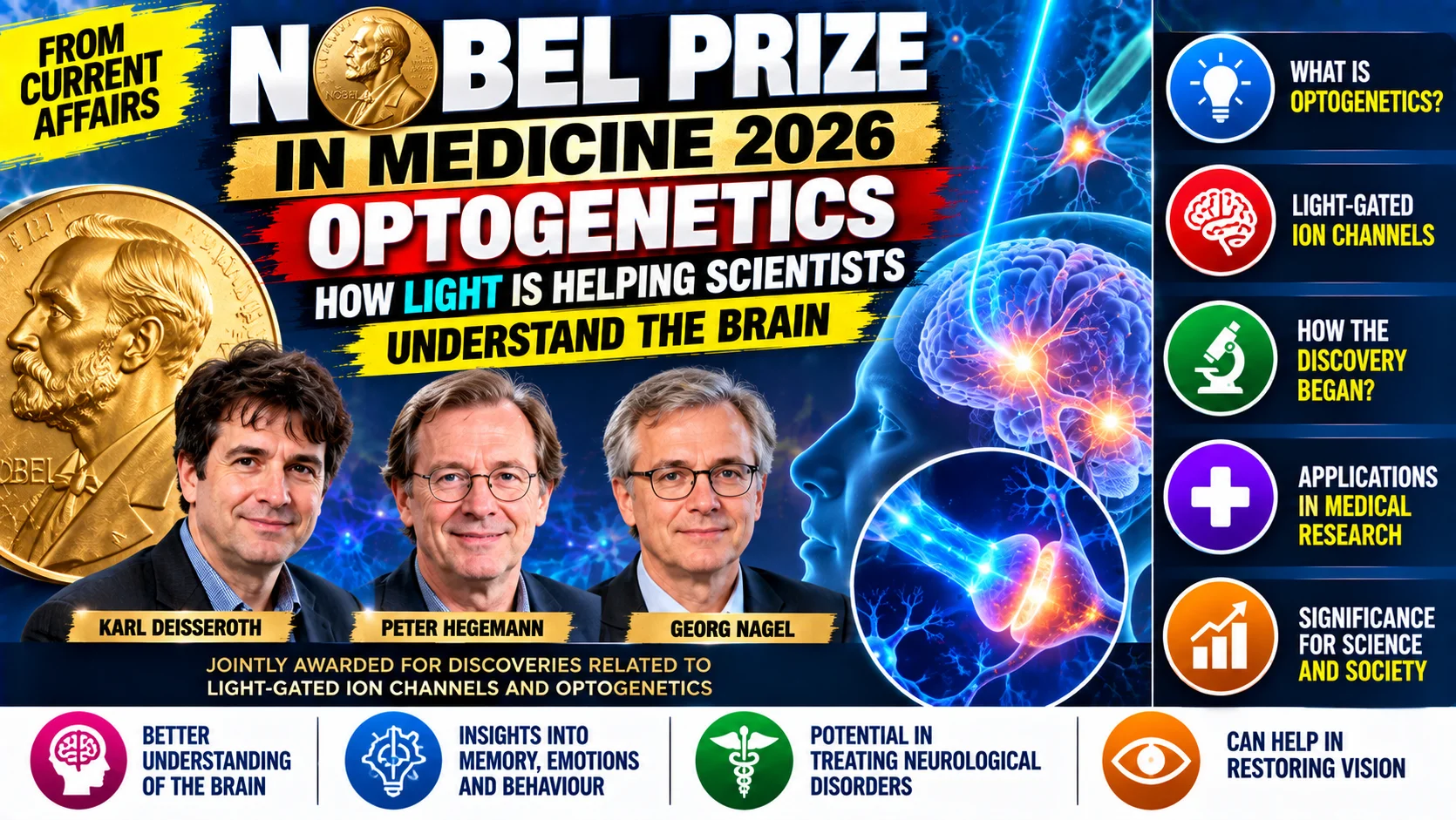
Nobel Prize in Physiology or Medicine 2026: How Light Is Helping Scientists Understand the Brain
The 2026 Nobel Prize in Physiology or Medicine has brought global attention to optogenetics, a scientific technique that allows researchers to control the activity of specific nerve cells using light. The prize was jointly awarded to Karl Deisseroth, Peter Hegemann and Georg Nagel for discoveries related to light-gated ion channels and optogenetics.
This is an important current-affairs topic because it connects biology, neuroscience, biotechnology and medical research.
What Is Optogenetics?
Optogenetics is a technique that combines genetic modification and light to control particular cells, especially neurons.
Normally, scientists can observe activity in the brain, but understanding whether a particular group of neurons actually causes a specific behaviour is much more difficult.
Optogenetics provides a way to address this problem. Scientists can make selected nerve cells sensitive to light and then use controlled light stimulation to activate or influence them.
This allows researchers to study how particular neural circuits are connected with memory, emotions and behaviour.
How Did the Discovery Begin?
The story began with research on a tiny single-celled alga called Chlamydomonas.
Peter Hegemann and Georg Nagel studied how this organism responds to light. Their work helped identify channelrhodopsin, a light-sensitive protein.
When exposed to blue light, the protein can form a channel through which charged particles move, producing an electrical response.
The researchers later demonstrated that introducing this protein into other cells could make those cells respond to light.
Karl Deisseroth subsequently helped transform this discovery into a practical method for controlling nerve cells. His work demonstrated that light could be used to trigger neural activity with considerable precision.
Why Is This Breakthrough Important?
1. Better Understanding of the Brain
The brain contains billions of neurons working through highly complex networks. Optogenetics allows researchers to investigate individual neural circuits rather than studying only broad regions of the brain.
2. Understanding Behaviour
Researchers can examine how particular neural pathways are associated with memory, emotions and behaviour.
3. Medical Research
Optogenetics is being investigated in areas involving neurological and psychiatric disorders. Researchers are also exploring its potential in approaches aimed at restoring vision in people with certain forms of visual impairment.
4. Combining Biology and Technology
The technique is an excellent example of how genetics, molecular biology, neuroscience and optical technology can work together to solve difficult scientific problems.
UPSC Relevance
For UPSC Prelims, remember:
- 2026 Nobel Prize in Physiology or Medicine
- Recipients: Karl Deisseroth, Peter Hegemann and Georg Nagel
- Key field: Optogenetics
- Important concept: Light-gated ion channels
- Important protein: Channelrhodopsin
- Major application: Studying and controlling neural activity
For UPSC Mains GS-III, the topic can be linked with:
- Biotechnology
- Neuroscience
- Genetic engineering
- Medical technology
- Scientific research and innovation
- Ethical questions surrounding biotechnology
Why Is It Relevant Beyond Medicine?
The Nobel-winning research demonstrates how basic scientific research can eventually create new technological possibilities.
The original scientific question involved how a tiny organism responds to light. Years of research transformed that knowledge into a technique capable of studying the complex workings of the mammalian brain.
This provides an important lesson for science policy: fundamental research may not always have an immediate application, but it can create the foundation for major breakthroughs in the future.
Conclusion
The 2026 Nobel Prize in Physiology or Medicine highlights how a discovery involving a light-sensitive protein in a simple organism eventually contributed to a powerful method for studying the brain.
For Civil Services aspirants, optogenetics is an excellent example of the intersection of basic science, biotechnology and medical innovation. Understanding the concept is more useful for examination preparation than simply memorising the names of the Nobel laureates.
Prepare for Civil Services with Grace IAS Academy
Grace IAS Academy provides structured preparation for UPSC and State Civil Services examinations through conceptual learning, current affairs, test practice and personal mentorship.
Students searching for Top IAS Coaching in Chandigarh, Best IAS Coaching in Chandigarh, Top UPSC Coaching in Chandigarh, Best UPSC Coaching in Chandigarh, Top Civil Services Coaching in Chandigarh, Best HCS Coaching in Chandigarh, Top HCS Coaching in Chandigarh, or Best PCS Coaching in Chandigarh can explore the courses and preparation support available at Grace IAS Academy.