Organisation
BRICS and India
BRICS and India: Why the Group Matters for India in 2026
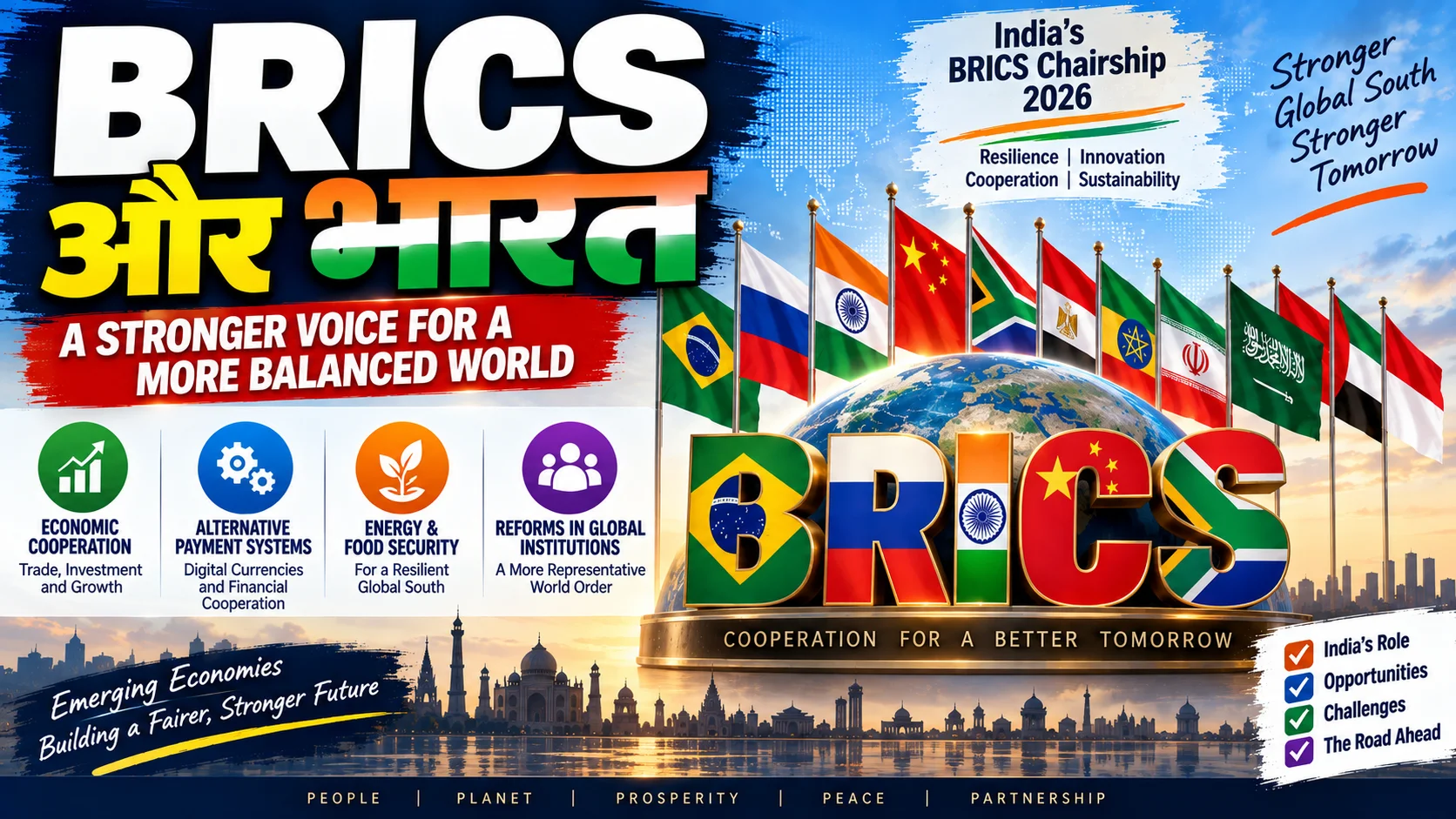
BRICS has become an important platform for emerging economies and is increasingly relevant to India’s foreign policy. In 2026, India holds the BRICS Chairship, giving New Delhi an opportunity to shape discussions on global governance, economic cooperation, technology, energy and the interests of the Global South. India formally assumed the chairship on 1 January 2026.
BRICS originally brought together Brazil, Russia, India and China, with South Africa joining later. The grouping has now expanded significantly. Its current members include Brazil, Russia, India, China, South Africa, Egypt, Ethiopia, Iran, Saudi Arabia, the United Arab Emirates and Indonesia.
Why is BRICS Important for India?
For India, BRICS is much more than an economic grouping. It provides a platform where India can engage simultaneously with major powers and developing countries.
One important objective is to make global institutions more representative. India has consistently supported reforms in institutions such as the United Nations Security Council, IMF and World Bank. BRICS gives India another platform to raise the concerns of developing countries and promote a more balanced international system.
India and the Global South
India sees BRICS as an important voice for the Global South. Many developing countries face common challenges such as food insecurity, energy security, climate change, development financing and access to technology.
India can use its BRICS leadership to promote practical cooperation in these areas rather than allowing the grouping to remain focused only on geopolitics.
India's 2026 BRICS theme focuses on resilience, innovation, cooperation and sustainability, reflecting this broader approach.
Trade and Digital Payments
Another important area is economic cooperation.
India is interested in making international payments easier and reducing excessive dependence on traditional payment channels. In 2026, India has been advocating greater interoperability between central bank digital currencies (CBDCs) among BRICS countries to facilitate cross-border payments. However, technical, financial and geopolitical challenges remain.
This does not necessarily mean replacing the US dollar. India's approach is more focused on creating additional and efficient payment options for international trade.
India-China Challenge
BRICS also presents a unique challenge for India because China is one of its most influential members.
India and China have important economic relations but also differences related to border security, trade and strategic competition. Therefore, India has to balance cooperation with China in multilateral forums while protecting its national interests.
The expected participation of Chinese President Xi Jinping at the 2026 BRICS Summit in New Delhi has attracted particular attention because it could provide an opportunity for dialogue between the two countries.
Energy and Economic Security
The expanded BRICS includes several major energy-producing countries. This creates opportunities for cooperation in oil, gas, renewable energy and energy security.
For India, which has large energy requirements, stronger relations with energy-producing countries can help diversify supplies and strengthen economic resilience.
BRICS cooperation also covers areas such as agriculture, health, science, technology and climate-related issues. India has been actively organising meetings across these sectors during its 2026 chairship.
Challenges Before BRICS
Despite its growing importance, BRICS faces several challenges.
The member countries have different political systems, economic interests and foreign-policy priorities. The expansion of the grouping has increased its geographical and economic reach but has also made consensus more difficult.
For example, tensions involving members with competing regional interests can make it difficult to formulate common positions on international crises.
Therefore, the future success of BRICS will depend on whether members can convert their common interests into practical cooperation.
What Should UPSC Aspirants Learn?
For Civil Services aspirants, BRICS connects with several important topics:
- India's Foreign Policy
- Global South
- Multipolar World
- Strategic Autonomy
- Global Governance
- Economic Diplomacy
- Digital Payments
- Energy Security
- India-China Relations
- Reform of International Institutions
The key point is that India does not have to choose between different international groupings. It can work with BRICS while simultaneously engaging through platforms such as G20, Quad and SCO according to its national interests.
BRICS provides India with an important opportunity to strengthen its voice in a changing world order. India's 2026 chairship gives it greater responsibility as well as greater diplomatic space.
The challenge for New Delhi is to ensure that BRICS remains a platform for development, cooperation and practical solutions, rather than becoming only a forum for geopolitical rivalry.
For Civil Services aspirants, BRICS is therefore an excellent example of India's policy of strategic autonomy and multi-alignment.
Grace IAS Academy – Civil Services Preparation
For aspirants searching for Top IAS Coaching in Chandigarh or Best IAS Coaching in Chandigarh, understanding international affairs through conceptual analysis is essential.
Students looking for Top UPSC Coaching in Chandigarh or Best UPSC Coaching in Chandigarh should connect Current Affairs with static subjects such as International Relations, Economy and Geography.
For State Civil Services preparation, Top Civil Services Coaching in Chandigarh, Best HCS Coaching in Chandigarh and Top HCS Coaching in Chandigarh are relevant searches for aspirants seeking structured guidance and regular Current Affairs preparation.
Similarly, candidates preparing for Punjab PCS can look for Best PCS Coaching in Chandigarh while developing strong foundations in General Studies, Current Affairs and answer writing.