
Latest news
Mangrove Ecosystem in India
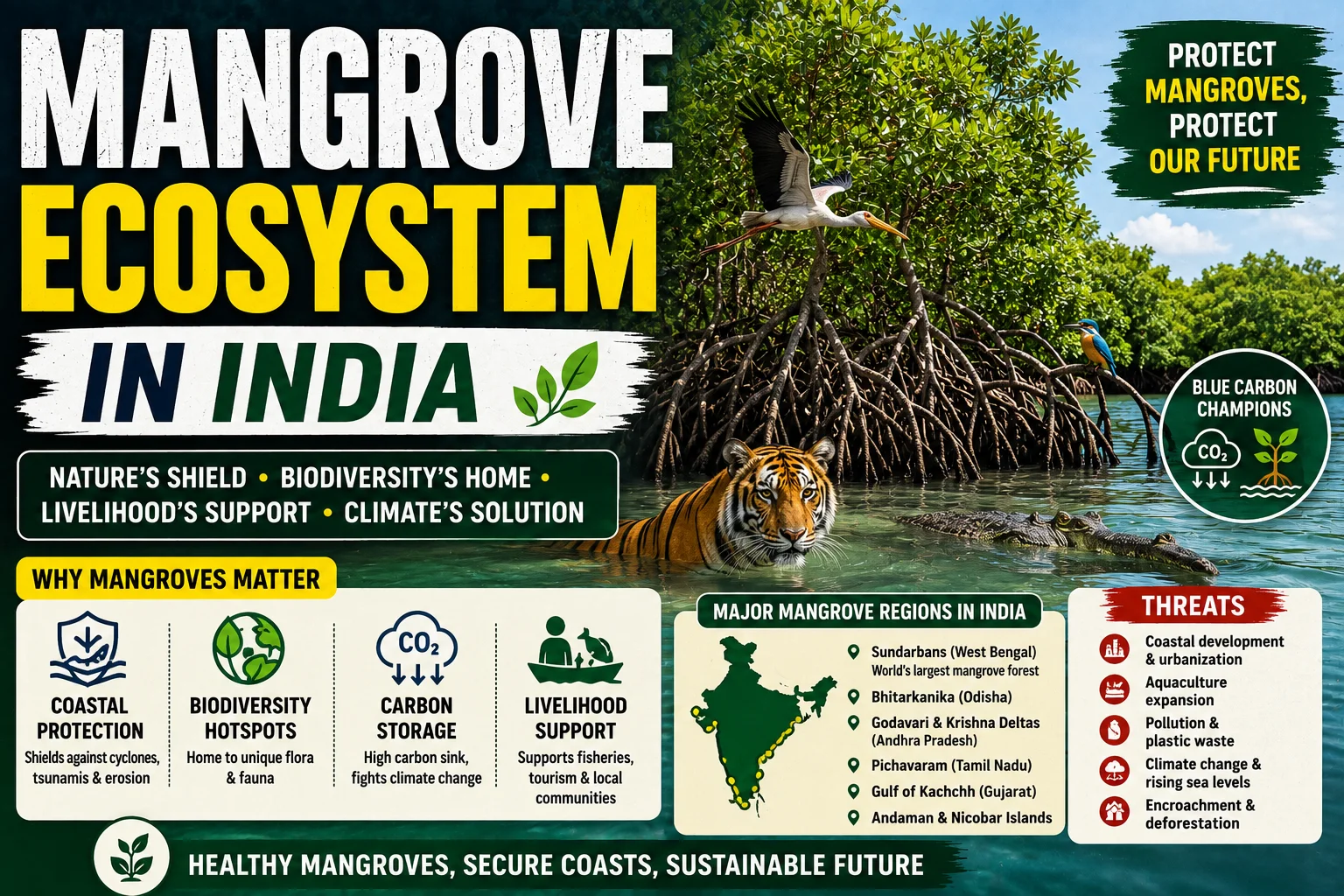
Mangrove Ecosystem in India: Importance, Distribution & Conservation
Mangrove forests are one of the most unique and productive ecosystems on Earth. Found along tropical and subtropical coastlines, these salt-tolerant forests serve as a natural shield between land and sea. India, with its long coastline of over 7,500 km, is home to diverse mangrove ecosystems that play a crucial role in protecting coastal communities, conserving biodiversity, and combating climate change.
For UPSC aspirants, Mangrove Ecosystem in India is an important topic under Environment, Ecology, Biodiversity, Geography, and Current Affairs.
What are Mangroves?
Mangroves are salt-tolerant trees and shrubs that grow in coastal intertidal zones, estuaries, river deltas, and tidal creeks. They thrive in saline water and muddy soils where very few plant species can survive.
These forests possess specialized aerial roots, known as pneumatophores, which help them absorb oxygen even in waterlogged conditions.
Distribution of Mangroves in India
India has one of the largest mangrove cover areas in the world. Major mangrove forests are found in:
-
Sundarbans (West Bengal) – The world's largest mangrove forest and a UNESCO World Heritage Site.
-
Bhitarkanika (Odisha)
-
Pichavaram (Tamil Nadu)
-
Godavari and Krishna Deltas (Andhra Pradesh)
-
Gulf of Kachchh (Gujarat)
-
Andaman & Nicobar Islands
These ecosystems support a rich variety of flora and fauna, including the endangered Royal Bengal Tiger, saltwater crocodiles, migratory birds, and numerous fish species.
Importance of Mangrove Ecosystems
Coastal Protection
Mangroves act as natural barriers against cyclones, tsunamis, storm surges, and coastal erosion by absorbing wave energy and stabilizing shorelines.
Biodiversity Conservation
Mangrove forests provide breeding, nesting, and feeding grounds for fish, crustaceans, birds, reptiles, and mammals, making them biodiversity hotspots.
Climate Change Mitigation
Mangroves are among the most efficient blue carbon ecosystems, storing significantly more carbon than many terrestrial forests. This helps reduce greenhouse gas concentrations and combat climate change.
Livelihood Support
Millions of coastal communities depend on mangroves for fisheries, honey collection, tourism, and sustainable forest products, contributing to local livelihoods and food security.
Threats to Mangroves
Despite their ecological importance, mangroves face several challenges:
-
Coastal urbanization and infrastructure development.
-
Aquaculture expansion.
-
Pollution and plastic waste.
-
Climate change and rising sea levels.
-
Illegal encroachment and deforestation.
These threats continue to reduce mangrove cover in many coastal regions.
Conservation Efforts
The Government of India has undertaken several initiatives to protect mangrove ecosystems through the National Coastal Mission, Integrated Coastal Zone Management (ICZM) Programme, and the Mangrove Initiative for Shoreline Habitats & Tangible Incomes (MISHTI) launched in 2023. Community participation, afforestation, and sustainable coastal management are also playing an important role in conservation.
Conclusion
Mangrove ecosystems are invaluable natural assets that protect coastlines, conserve biodiversity, support livelihoods, and help combat climate change. Their role has become even more significant in the face of increasing climate-related disasters and coastal degradation.