
Organisation
Gaganyaan Parachute System
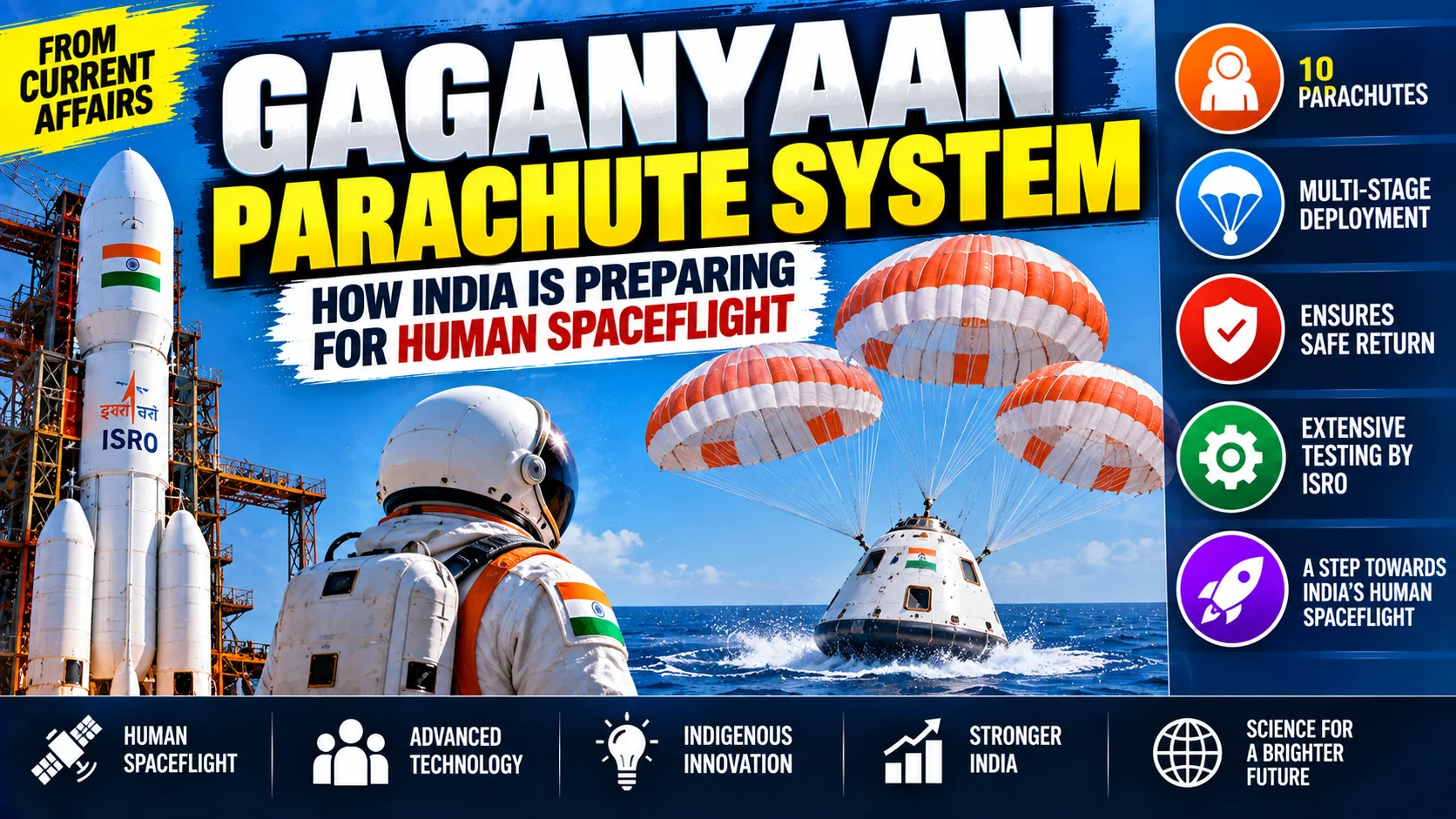
Gaganyaan Parachute System: How India Is Preparing for Human Spaceflight
India’s Gaganyaan Mission is one of the country’s most important space programmes. As India prepares for human spaceflight, the focus is not only on launching astronauts into space but also on bringing them back safely to Earth. One of the most important technologies for this is the Crew Module parachute system.
Recent developments in Gaganyaan’s parachute and recovery systems show how ISRO is testing critical technologies before astronauts are sent into space. ISRO has carried out several air-drop and ground tests to check the performance of the system under different conditions.
What Is Gaganyaan?
Gaganyaan is India’s human spaceflight programme. Its objective is to demonstrate India's ability to send humans to Low Earth Orbit (LEO) and safely return them to Earth.
According to ISRO, the programme includes uncrewed missions for testing safety and reliability before the crewed mission. The programme requires several advanced technologies, including a human-rated launch vehicle, crew escape system, life-support system and crew module.
Why Are Parachutes So Important?
After a spacecraft returns from space, the Crew Module enters the atmosphere at very high speed. It must slow down before reaching the sea surface.
This is where the parachute system becomes extremely important.
The Gaganyaan Crew Module uses 10 parachutes of four different types. The sequence begins with parachutes that separate the protective cover. Drogue parachutes then help stabilise and slow the module. Pilot parachutes subsequently deploy the main parachutes, which reduce the speed further for a safe splashdown.
The system also includes redundancy. ISRO's testing has been designed to examine how the parachutes perform under different and challenging conditions.
How Is ISRO Testing the System?
ISRO has used several types of tests.
The Integrated Air Drop Tests (IADT) use aircraft to release a representative Crew Module and evaluate the complete parachute-based deceleration system.
Ground-based tests have also been conducted using the Rail Track Rocket Sled (RTRS) facility. These tests help examine parachute behaviour under extreme dynamic-pressure conditions.
ISRO has also conducted Integrated Main Parachute Airdrop Tests (IMAT) to qualify the main parachute system. These tests are important because a human spaceflight mission requires very high levels of reliability.
Why Is This Important for India?
Gaganyaan is more than a single space mission. It is expected to strengthen India's capabilities in human spaceflight, advanced engineering, life-support technology, space medicine and scientific research.
ISRO also says the programme can encourage industry-academia cooperation, develop specialised human resources and create technologies that can support future human and robotic space missions.
The programme could also become a foundation for India's longer-term human presence in space and future space-station activities.
UPSC Relevance
This topic is important for UPSC and State PCS examinations under Science & Technology, Space Technology, India's space programme and indigenous technological development.
For aspirants searching for Top IAS Coaching in Chandigarh or Best IAS Coaching in Chandigarh, topics such as Gaganyaan provide excellent examples for connecting current affairs with the static syllabus.
Students looking for Top UPSC Coaching in Chandigarh or Best UPSC Coaching in Chandigarh should understand concepts such as LEO, re-entry, crew escape systems, parachute-based deceleration and human-rated launch vehicles.
Similarly, Top Civil Services Coaching in Chandigarh, Best HCS Coaching in Chandigarh, Top HCS Coaching in Chandigarh, and Best PCS Coaching in Chandigarh are useful search terms for students exploring civil-services preparation options.
Grace IAS Academy focuses on connecting current affairs with static concepts so that aspirants understand not only what happened, but also how the technology works and why it matters for India.