
Organisation
India’s Rs1.10 Lakh Crore Defence Push
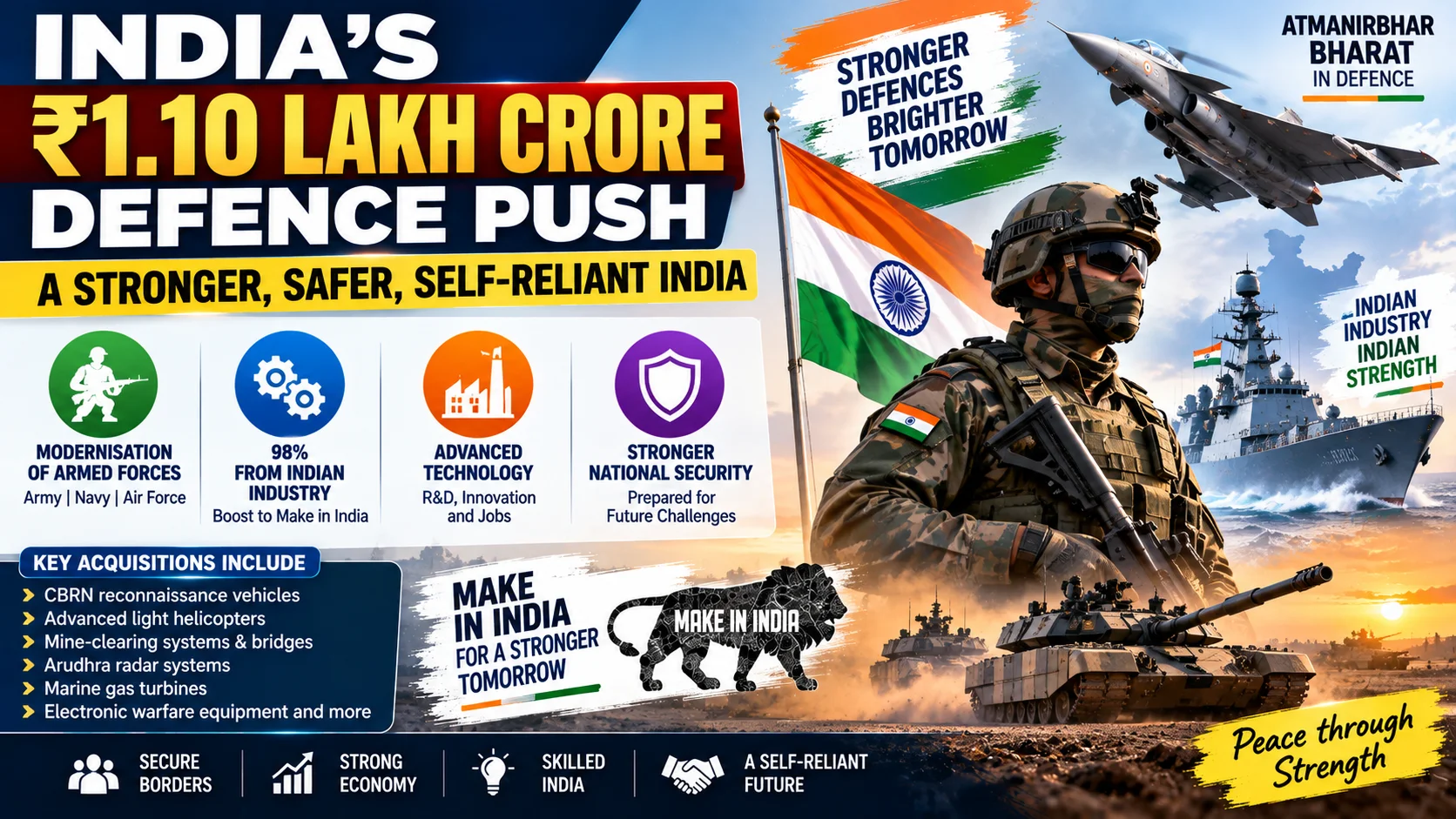
India’s ₹1.10 Lakh Crore Defence Push: A Major Step Towards Self-Reliance
India has taken a major step to strengthen its defence preparedness. On 7 September 2026, the Defence Acquisition Council (DAC), chaired by Defence Minister Rajnath Singh, gave Acceptance of Necessity (AoN) to defence acquisition proposals worth around ₹1.10 lakh crore. The proposals cover the Indian Army, Navy and Air Force. Around 98% of the approved procurement is planned from Indian industry, making the decision important for both national security and defence manufacturing.
What is the Defence Acquisition Council?
The Defence Acquisition Council (DAC) is the highest decision-making body in the Ministry of Defence for defence procurement. It is chaired by the Defence Minister.
The recent decision does not mean that all the equipment has already been purchased. The DAC has granted Acceptance of Necessity, which is an important initial approval in the defence procurement process. Further stages are required before actual contracts and deliveries take place.
What Will India Procure?
The approved proposals cover a wide range of military equipment and systems.
For the Indian Army, the proposals include CBRN reconnaissance vehicles, high-mobility vehicles, advanced light helicopters, mechanical mine layers, mine-clearing equipment and bridge systems.
For the Indian Navy, the plans include Arudhra radar systems and the development of marine gas turbines for warship propulsion.
For the Indian Air Force, the proposals include equipment for electronic warfare and other systems to improve operational capabilities.
These acquisitions are aimed at improving the ability of India's armed forces to respond to changing security challenges.
Why Is 98% Domestic Procurement Important?
The most important feature of the announcement is the emphasis on Indian industry.
Around 98% of the approved procurement is expected to come from domestic sources. This supports the broader objective of Atmanirbhar Bharat and defence indigenisation.
Greater domestic production can reduce India's dependence on foreign suppliers. It can also encourage investment in defence research, manufacturing and advanced technologies.
A stronger domestic defence industry can create skilled employment and help Indian companies develop capabilities that may eventually support defence exports.
Importance for National Security
Modern warfare is changing rapidly. Drones, electronic warfare, advanced radars, precision systems and network-based operations are becoming increasingly important.
Therefore, simply increasing the number of weapons is not enough. India also needs modern technology, reliable supply chains and faster indigenous production.
The latest procurement proposals are aimed at improving the operational preparedness of all three services and strengthening India's overall security architecture.
Challenges Ahead
Large defence procurement programmes also involve challenges.
India needs to ensure that indigenous manufacturers have sufficient production capacity, technology and skilled manpower. Timely delivery is equally important.
There is also a need for continuous investment in research and development (R&D) so that India does not remain dependent on foreign technology even when equipment is manufactured domestically.
Therefore, self-reliance should mean not only “Make in India”, but increasingly “Design and Develop in India.”
Why Is This Important for UPSC?
This current affair is highly relevant to UPSC and State PCS examinations. It connects with topics such as:
- Defence indigenisation
- Atmanirbhar Bharat
- Defence Acquisition Council
- Make in India
- National Security
- Defence manufacturing
- Research and Development
- Military modernisation
- Defence exports
- Emerging technologies
Aspirants should understand the difference between procurement, indigenous production and technological self-reliance.
The approval of defence proposals worth ₹1.10 lakh crore represents a major push towards military modernisation. More importantly, the proposed 98% domestic sourcing highlights India's growing focus on self-reliance in defence.
The real impact, however, will depend on successful implementation, timely delivery and India's ability to develop critical defence technologies domestically.
For Civil Services aspirants, this development is a useful example of how national security, technology, industry and economic policy are closely connected.
Grace IAS Academy – Civil Services Preparation
For aspirants searching for Top IAS Coaching in Chandigarh or Best IAS Coaching in Chandigarh, understanding Current Affairs through the lens of the UPSC syllabus is essential.
Students looking for Top UPSC Coaching in Chandigarh or Best UPSC Coaching in Chandigarh should focus on conceptual learning, regular Current Affairs revision, answer writing and test practice.
For State Civil Services preparation, Top Civil Services Coaching in Chandigarh, Best HCS Coaching in Chandigarh and Top HCS Coaching in Chandigarh are relevant searches for structured guidance and comprehensive preparation.
Similarly, aspirants preparing for Punjab PCS may consider Best PCS Coaching in Chandigarh while building strong foundations in General Studies, Current Affairs and analytical writing.