
Organisation
Nepal Flash Flood
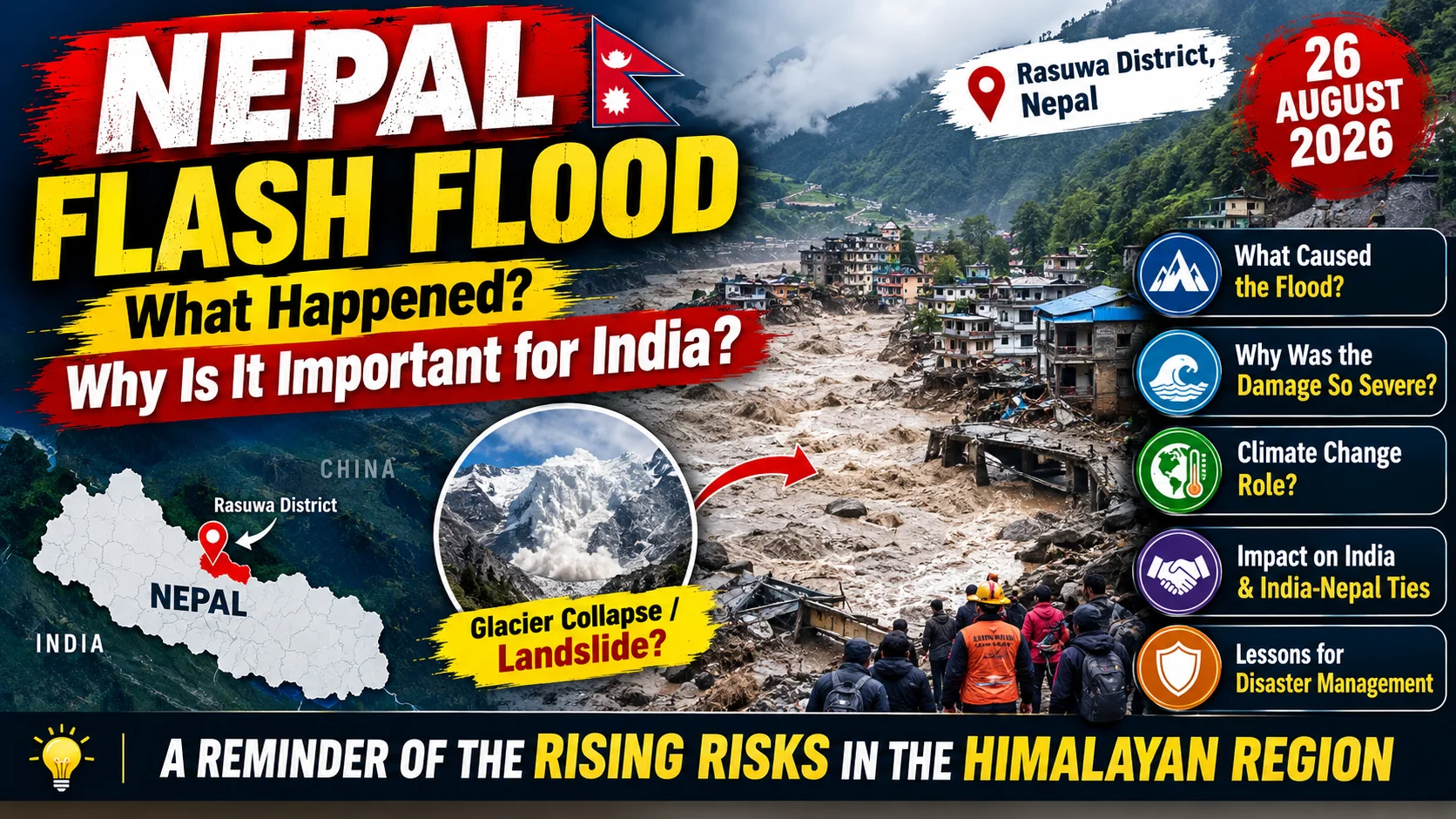
Nepal Flash Flood: What Happened and Why Is It Important for India?
A devastating flash flood struck northern Nepal on 26 August 2026, particularly affecting areas around the Rasuwa district and the Bhotekoshi River system near the Nepal–Tibet border. The disaster caused extensive loss of life and damage to roads, bridges, settlements and hydropower infrastructure. Hundreds of people have also been reported missing.
The event has attracted attention not only because of its scale but also because of the unusual chain of geological and climatic factors that may have contributed to it.
What Caused the Flash Flood?
Initial reports suggested that an earthquake might have triggered the disaster. However, subsequent assessments pointed towards a large ice-rock avalanche or landslide associated with a glacier collapse as a major possible trigger. Scientists are still examining the exact sequence of events.
A sudden collapse of ice and rock in the high Himalayas can send huge quantities of debris into a river. In a narrow mountain valley, this can temporarily block water and then release it suddenly, producing a powerful flood wave.
This is different from an ordinary monsoon flood, which generally develops more gradually.
Why Was the Damage So Severe?
Nepal's geography makes many Himalayan valleys particularly vulnerable to flash floods. The country has extremely steep mountains and narrow, deep river valleys. These valleys can act like natural channels, accelerating floodwater and debris as they move downstream.
The recent flood damaged or destroyed houses, roads, bridges and other infrastructure. Several areas became difficult to access, making rescue and relief operations more challenging.
The disaster also affected important transport links between Nepal and Tibet.
Climate Change and the Himalayan Region
The incident has once again highlighted concerns about climate change and the stability of Himalayan glaciers.
Rising temperatures can accelerate glacier melting and contribute to changes in high-altitude environments. Scientists have warned that melting ice, unstable slopes and changing precipitation patterns can increase the risks associated with landslides, glacial lake outburst floods and other mountain hazards.
However, it is important not to attribute every individual flood directly to climate change. The precise causes of this particular event are still being investigated.
Why Is Nepal's Flood Important for India?
Nepal and India share several important river systems. The recent flood has raised concerns in parts of Bihar and Uttar Pradesh, as water from Nepal can move downstream through the Narayani-Gandak river system. Indian authorities have therefore been monitoring the situation and preparing for possible downstream impacts.
This highlights the importance of India-Nepal cooperation in disaster management, flood forecasting, river management and early-warning systems.
Lessons for Disaster Management
The Nepal flash flood provides several important lessons:
- Strengthening early-warning systems
- Better monitoring of glaciers and unstable mountain slopes
- Improved disaster-response infrastructure
- Sharing hydrological and weather information between neighbouring countries
- Developing climate-resilient infrastructure
- Conducting regular evacuation and preparedness exercises
For India, cooperation with Himalayan neighbours is particularly important because rivers do not follow political boundaries.
Why Is This Important for Civil Services Aspirants?
The Nepal flash flood is an important Current Affairs topic for UPSC and State PCS examinations. It can be linked with Himalayan geography, climate change, disaster management, glacial hazards, international relations, India-Nepal relations and river systems.
Aspirants should focus not only on the incident but also on the larger question: How can Himalayan countries prepare for increasingly complex natural hazards?
Grace IAS Academy – Civil Services Preparation in Chandigarh
For aspirants searching for Top IAS Coaching in Chandigarh, Grace IAS Academy focuses on connecting current affairs with the static syllabus and examination requirements.
Students looking for Best IAS Coaching in Chandigarh, Top UPSC Coaching in Chandigarh or Best UPSC Coaching in Chandigarh can benefit from an integrated approach covering concepts, current affairs, Prelims practice and Mains answer writing.
For State Civil Services aspirants, Top Civil Services Coaching in Chandigarh, Best HCS Coaching in Chandigarh and Top HCS Coaching in Chandigarh are relevant options for structured and examination-oriented preparation.
Similarly, students preparing for Punjab PCS can look for Best PCS Coaching in Chandigarh, with emphasis on syllabus coverage, regular testing, revision and mentorship.