
Latest news
Artificial Intelligence in Governance
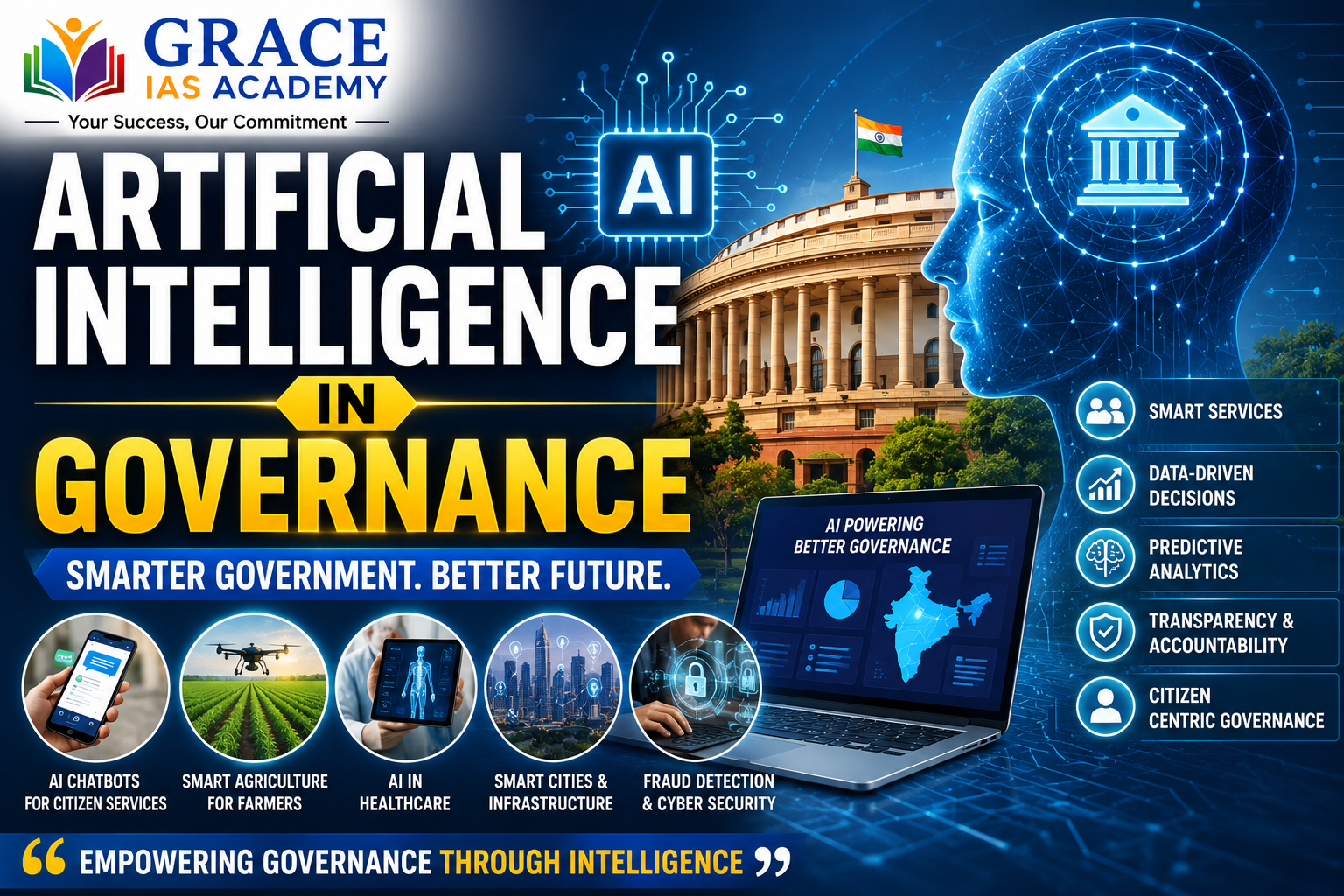
Artificial Intelligence in Governance: Meaning, Applications, Benefits & Challenges
Artificial Intelligence (AI) is transforming the way governments function across the world. From improving public service delivery to enhancing policy implementation and decision-making, AI has become a powerful tool for modern governance. In India, the government is increasingly adopting Artificial Intelligence to improve transparency, efficiency, and citizen-centric services.
For UPSC aspirants, Artificial Intelligence in Governance is an important topic under Science & Technology, Governance, Digital India, Ethics, and Current Affairs.
What is Artificial Intelligence?
Artificial Intelligence (AI) refers to the ability of machines and computer systems to perform tasks that normally require human intelligence. These tasks include learning, reasoning, problem-solving, language understanding, decision-making, and pattern recognition.
AI technologies include:
-
Machine Learning (ML)
-
Natural Language Processing (NLP)
-
Computer Vision
-
Robotics
-
Predictive Analytics
These technologies help governments analyze vast amounts of data and deliver faster, more accurate public services.
Role of Artificial Intelligence in Governance
AI is revolutionizing governance by making government services more efficient, transparent, and accessible.
Improving Public Service Delivery
Governments are using AI-powered chatbots and virtual assistants to answer citizen queries, process applications, and provide information 24×7. This reduces waiting time and improves service quality.
Better Decision-Making
AI can analyze large datasets to identify trends, predict future challenges, and assist policymakers in making evidence-based decisions. This is particularly useful in sectors like healthcare, agriculture, disaster management, and urban planning.
Smart Healthcare
Artificial Intelligence supports disease prediction, medical diagnosis, telemedicine, and hospital resource management. AI-based health systems can improve access to quality healthcare, especially in remote areas.
Smart Agriculture
AI helps farmers through weather forecasting, crop monitoring, soil analysis, pest detection, and precision farming. This leads to improved productivity and sustainable agricultural practices.
Efficient Tax Administration
AI assists tax authorities in detecting fraud, identifying tax evasion, and improving compliance through data analytics.
Disaster Management
AI-powered predictive models help governments prepare for floods, cyclones, earthquakes, and other natural disasters by providing early warnings and better resource allocation.
Benefits of AI in Governance
Artificial Intelligence offers several advantages for public administration:
-
Faster delivery of government services
-
Improved transparency and accountability
-
Better policy formulation using data analytics
-
Reduced administrative costs
-
Efficient grievance redressal
-
Enhanced citizen satisfaction
-
Better monitoring of government schemes
AI also supports India's vision of Digital India by making governance more technology-driven and citizen-friendly.
Challenges of AI in Governance
Despite its immense potential, AI presents several challenges.
Data Privacy
Government AI systems process large volumes of personal information, raising concerns about privacy and data protection.
Algorithmic Bias
AI systems may produce biased outcomes if trained on incomplete or discriminatory datasets.
Cybersecurity Risks
Increased dependence on digital systems makes government infrastructure more vulnerable to cyberattacks.