
Latest news
Women Reservation Act
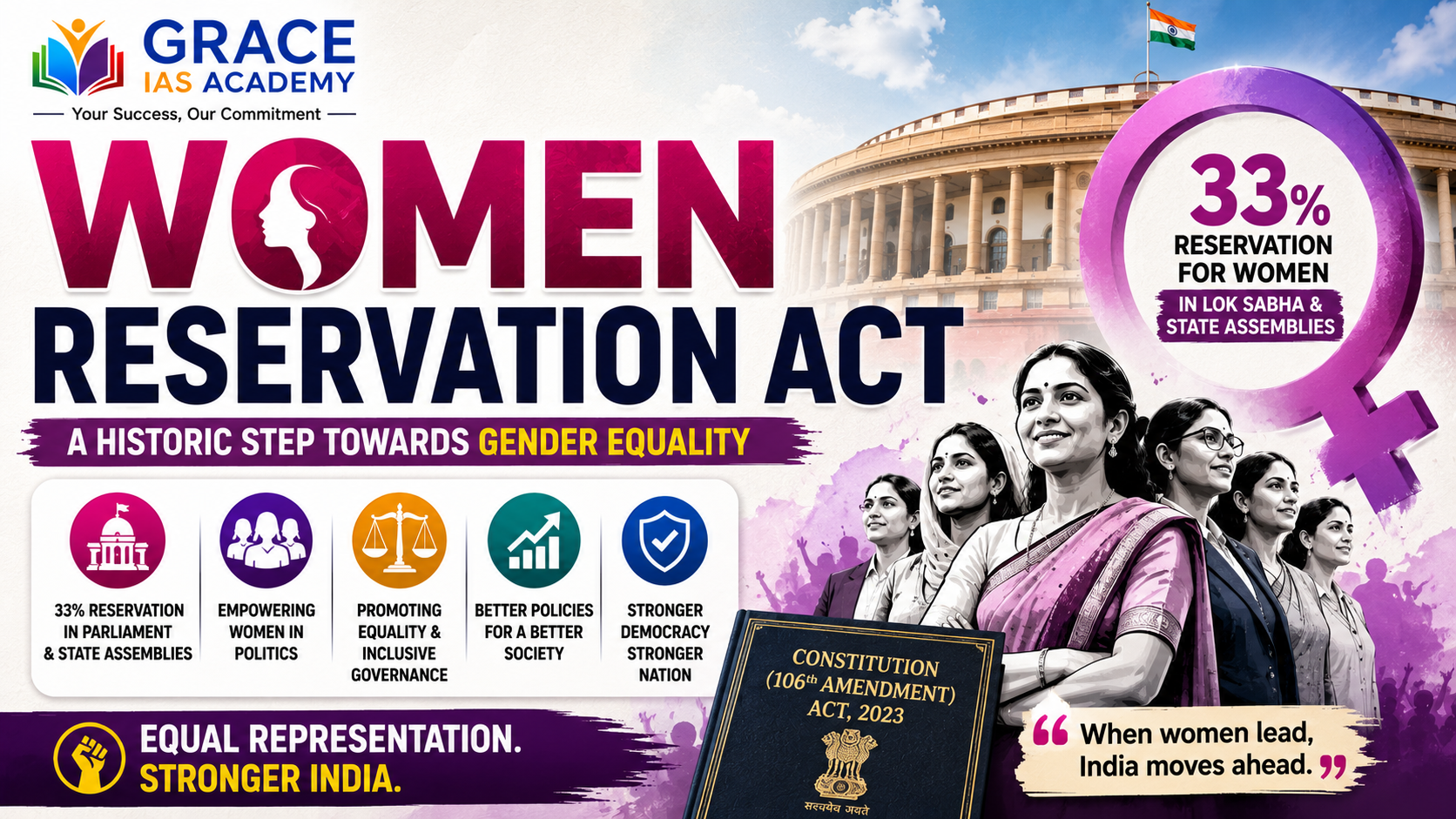
Women Reservation Act: Meaning, Features, Significance & Challenges
The Women Reservation Act, officially known as the Constitution (106th Amendment) Act, 2023, is a landmark reform in India's democratic journey. It aims to enhance the political participation of women by reserving one-third (33%) of seats in the Lok Sabha and State Legislative Assemblies. The legislation marks a significant step toward achieving gender equality, inclusive governance, and stronger democratic representation.
For UPSC aspirants, the Women Reservation Act is an important topic under Indian Polity, Governance, Constitution, and Current Affairs.
What is the Women Reservation Act?
The Women Reservation Act provides 33% reservation for women in:
-
Lok Sabha (House of the People)
-
State Legislative Assemblies
-
Seats reserved for Scheduled Castes (SCs) and Scheduled Tribes (STs)
The Act seeks to increase women's participation in the legislative process and ensure that women have a stronger voice in policymaking and governance.
Constitutional Background
The Constitution of India guarantees equality before law (Article 14) and prohibits discrimination based on sex under Article 15. It also empowers the State to make special provisions for women under Article 15(3).
While reservation for women has existed in Panchayats and Urban Local Bodies through the 73rd and 74th Constitutional Amendments, there was no similar provision for Parliament and State Legislatures until the Women Reservation Act.
Key Features of the Women Reservation Act
The Act introduces several important provisions:
-
Reservation of 33% seats for women in the Lok Sabha.
-
Reservation of 33% seats for women in State Legislative Assemblies.
-
One-third of seats reserved for SCs and STs will also be reserved for women belonging to these communities.
-
Reserved constituencies will rotate after every delimitation exercise.
-
The reservation will come into effect after the next Census and the subsequent delimitation process.
Why is the Women Reservation Act Important?
Promotes Gender Equality
The Act aims to provide equal opportunities for women to participate in the country's political decision-making process.
Strengthens Democracy
Greater representation of women makes democratic institutions more inclusive and representative of society.
Better Policy Outcomes
Research across the world suggests that higher participation of women often leads to greater focus on education, healthcare, nutrition, sanitation, and social welfare.
Encourages Political Participation
The legislation is expected to motivate more women to enter politics and assume leadership roles at various levels.
Challenges and Concerns
Despite its significance, several concerns have been raised regarding the implementation of the Act.
Delayed Implementation
The reservation will become operational only after the completion of the Census and the delimitation exercise, which may delay its actual implementation.
Rotation of Reserved Seats
Frequent rotation of constituencies may discourage long-term political investment by elected representatives.
Demand for Sub-Quota
Several political parties have demanded a separate reservation within the women's quota for Other Backward Classes (OBCs) and other marginalized groups.
Representation vs Empowerment
Some experts argue that reservation alone may not guarantee meaningful participation unless women receive adequate political training, resources, and institutional support.
Impact on Indian Democracy
The Women Reservation Act has the potential to transform India's political landscape by significantly increasing women's representation in legislative bodies. It is expected to improve gender-sensitive policymaking, strengthen democratic institutions, and inspire greater participation of women in public life.
The Act also reinforces India's commitment to inclusive governance and constitutional equality.