
Latest news
National Green Hydrogen Mission
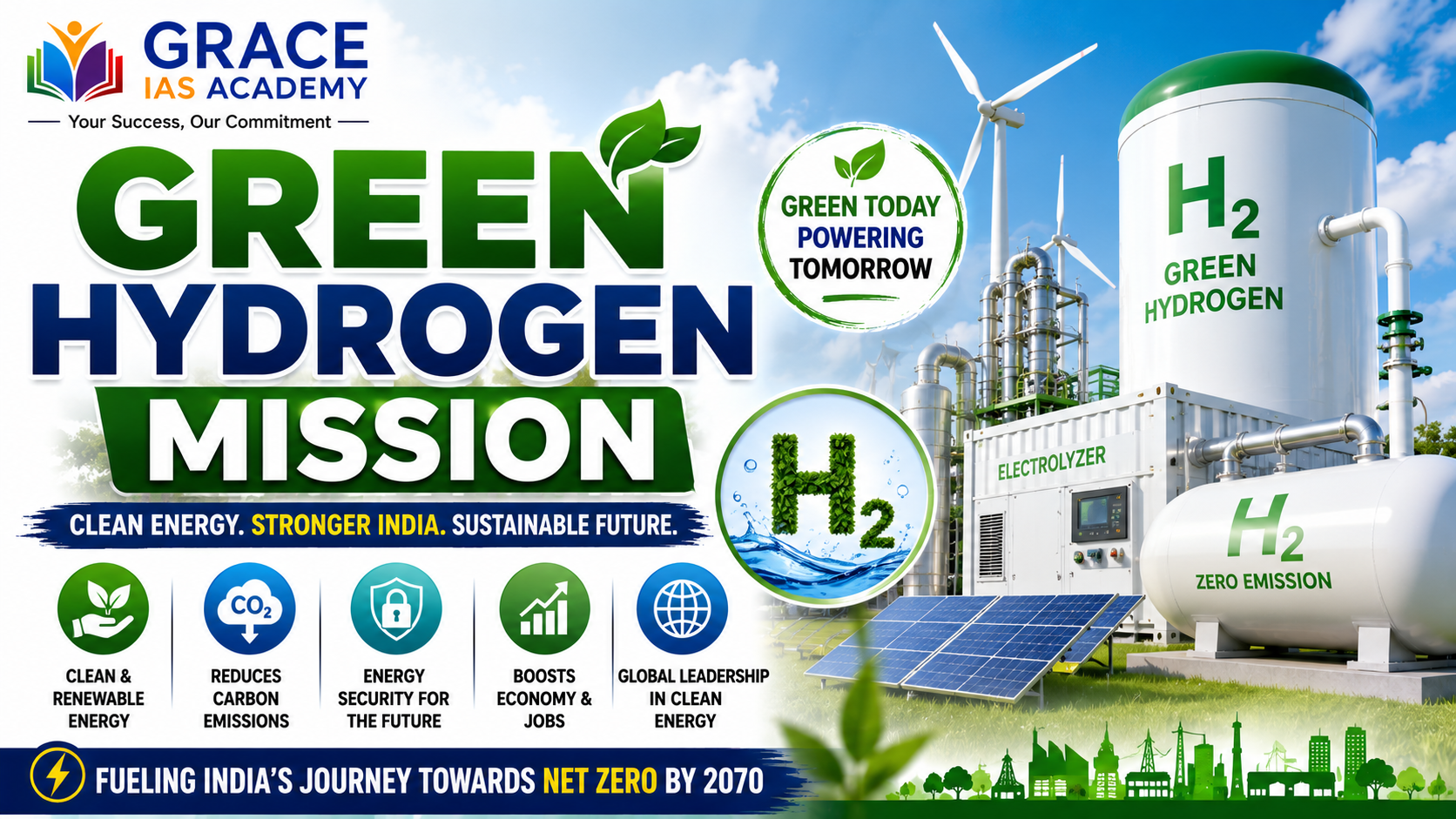
National Green Hydrogen Mission: Meaning, Objectives, Benefits & Challenges
As the world moves towards clean and sustainable energy, Green Hydrogen has emerged as a promising alternative to fossil fuels. Recognizing its potential, the Government of India launched the National Green Hydrogen Mission in January 2023 to make India a global hub for the production, utilization, and export of green hydrogen. The mission is a significant step towards achieving energy security, reducing carbon emissions, and fulfilling India's climate commitments.
For UPSC aspirants, the National Green Hydrogen Mission is an important topic under Environment, Economy, Science & Technology, and Current Affairs.
What is Green Hydrogen?
Green Hydrogen is hydrogen produced by splitting water into hydrogen and oxygen through a process called electrolysis, using electricity generated from renewable energy sources such as solar and wind power.
Unlike grey or blue hydrogen, green hydrogen produces no carbon emissions during its production process, making it one of the cleanest fuels available.
What is the National Green Hydrogen Mission?
The National Green Hydrogen Mission is a flagship initiative launched by the Government of India to promote the production, storage, transportation, and use of green hydrogen across various sectors.
The mission aims to establish India as a global leader in green hydrogen while supporting the country's transition towards clean energy.
Objectives of the Mission
The major objectives of the National Green Hydrogen Mission include:
-
Making India a global hub for green hydrogen production.
-
Reducing dependence on imported fossil fuels.
-
Promoting clean and sustainable energy.
-
Encouraging domestic manufacturing of electrolyzers.
-
Supporting India's Net Zero emission target by 2070.
-
Generating employment and attracting investment in the renewable energy sector.
Why is Green Hydrogen Important?
Energy Security
India imports a significant portion of its crude oil and natural gas requirements. Green hydrogen can reduce dependence on imported fuels and improve long-term energy security.
Clean Energy Transition
Green hydrogen produces no greenhouse gas emissions during production or usage, helping India reduce its carbon footprint.
Industrial Decarbonization
Industries such as steel, cement, fertilizers, and refineries are difficult to decarbonize using conventional renewable energy. Green hydrogen provides a cleaner alternative for these sectors.
Export Opportunities
India has abundant renewable energy potential, making it well-positioned to become a major exporter of green hydrogen and its derivatives.
Key Benefits of the Mission
The National Green Hydrogen Mission is expected to:
-
Promote renewable energy development.
-
Reduce greenhouse gas emissions.
-
Improve energy independence.
-
Create new employment opportunities.
-
Boost technological innovation.
-
Strengthen India's position in the global clean energy market.
The mission also supports initiatives such as Atmanirbhar Bharat and sustainable economic growth.
Challenges
Despite its enormous potential, the mission faces several challenges.
High Production Cost
Currently, green hydrogen is more expensive than conventional hydrogen produced from fossil fuels.
Infrastructure Requirements
Large-scale production requires significant investment in renewable energy, electrolyzers, storage facilities, pipelines, and transportation infrastructure.
Technology Development
India needs continuous research and innovation to improve electrolyzer efficiency and reduce production costs.
Water Availability
Electrolysis requires substantial quantities of purified water, which may become challenging in water-scarce regions.
Significance for India
The National Green Hydrogen Mission aligns with India's commitments under the Paris Agreement and its target of achieving Net Zero emissions by 2070. It also contributes to energy security, industrial competitiveness, sustainable development, and economic growth.
By investing in green hydrogen today, India aims to become a leading player in the future global clean energy economy.