Latest news
One Nation One Election
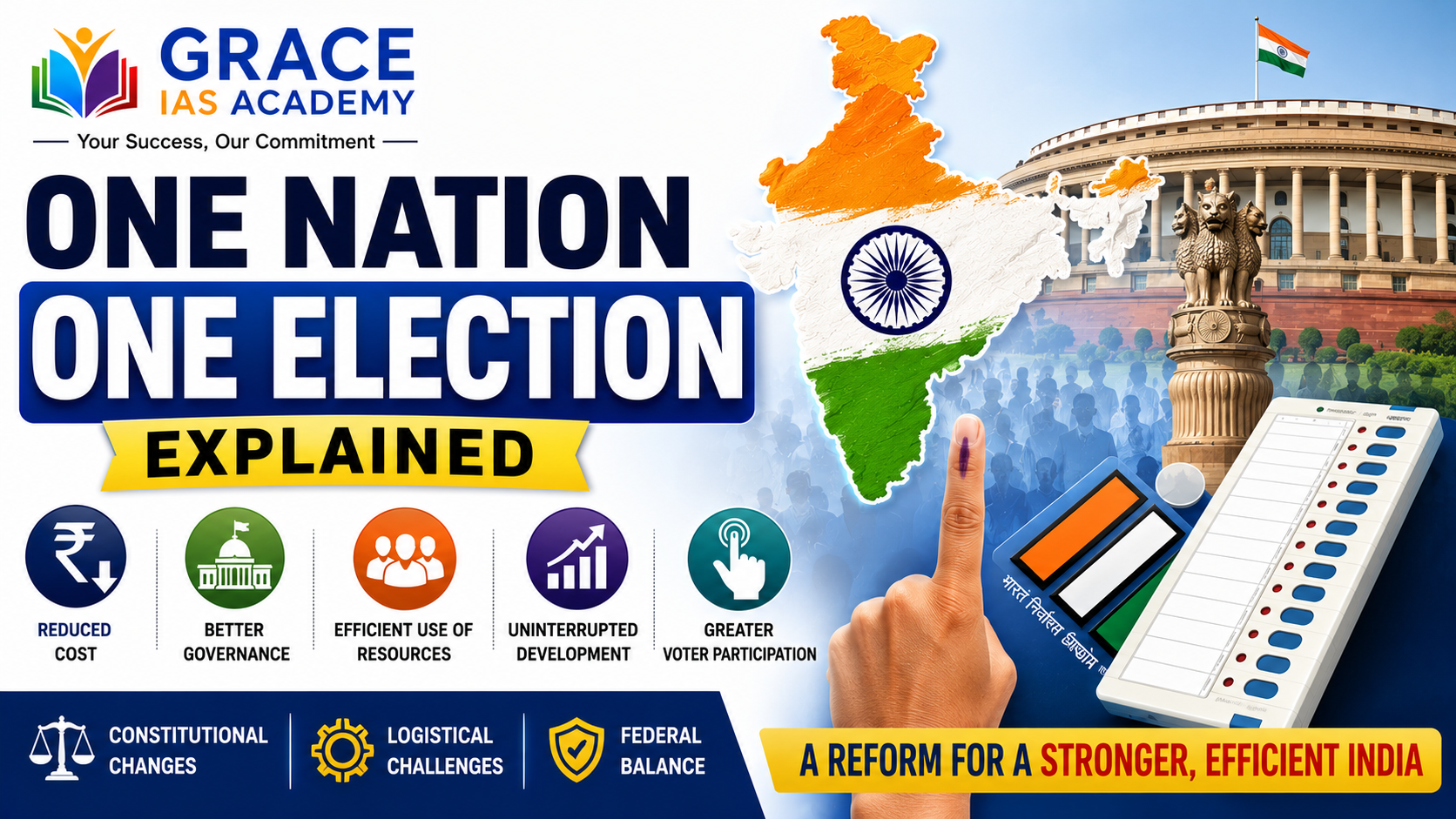
One Nation One Election Explained: Meaning, Advantages, Challenges & Impact
The concept of One Nation, One Election (ONOE) has become one of the most discussed electoral reforms in India. The proposal aims to conduct elections for the Lok Sabha and all State Legislative Assemblies simultaneously, instead of holding them at different times throughout the year. Supporters believe it can reduce election costs and improve governance, while critics argue that it may affect India's federal structure and democratic process. Given its constitutional and political significance, the topic is highly relevant for UPSC and State PCS examinations.
What is One Nation, One Election?
One Nation, One Election refers to the idea of holding elections to the Lok Sabha and all State Assemblies at the same time across the country.
Under the current system, elections are held whenever the term of a legislature ends or when an Assembly is dissolved. As a result, India witnesses elections almost every year in one or more states.
The ONOE proposal seeks to synchronize these election cycles so that voters cast their votes for both Parliament and State Assemblies during a single election period.
Why is One Nation, One Election Being Proposed?
The primary objective of ONOE is to improve governance and reduce the frequent disruptions caused by repeated elections.
Some of the major reasons include:
-
Reducing the enormous expenditure on conducting elections.
-
Minimizing frequent deployment of security forces and government officials.
-
Reducing the impact of the Model Code of Conduct on governance.
-
Ensuring uninterrupted implementation of development projects.
-
Improving administrative efficiency.
Advantages of One Nation, One Election
Reduced Election Expenditure
Conducting elections simultaneously can significantly reduce expenditure incurred by the Election Commission, political parties, and governments.
Better Governance
Frequent elections often delay policy decisions due to the Model Code of Conduct. Simultaneous elections would allow governments to focus more on governance and development.
Efficient Use of Resources
Security personnel, polling staff, and administrative machinery can be utilized more efficiently if elections are conducted together.
Greater Voter Participation
Holding all elections together may improve voter turnout by reducing voter fatigue and increasing public participation.
Challenges of One Nation, One Election
Constitutional Amendments
Implementing ONOE would require amendments to several constitutional provisions related to the tenure and dissolution of Parliament and State Assemblies.
Federal Concerns
Critics argue that simultaneous elections may weaken India's federal structure by reducing the importance of regional issues during elections.
Logistical Challenges
Conducting nationwide elections simultaneously requires massive deployment of Electronic Voting Machines (EVMs), polling personnel, and security forces.
Political Challenges
Synchronizing the tenure of all State Assemblies with the Lok Sabha would require extending or curtailing the terms of some legislatures, which may face political opposition.
Constitutional Provisions Involved
The implementation of One Nation, One Election may require changes to provisions such as:
-
Article 83 – Duration of Lok Sabha
-
Article 85 – Dissolution of Lok Sabha
-
Article 172 – Duration of State Legislatures
-
Article 174 – Sessions and dissolution of State Assemblies
-
Article 356 – President's Rule
Any such reforms would require broad political consensus and constitutional amendments.
Impact on Indian Democracy
If implemented effectively, One Nation, One Election could improve governance, reduce election-related expenditure, and streamline the electoral process. However, concerns regarding federalism, regional representation, and democratic accountability would need to be carefully addressed.
A balanced approach is essential to ensure that electoral efficiency does not come at the cost of constitutional principles.