
Latest news
Uniform Civil Code (UCC)
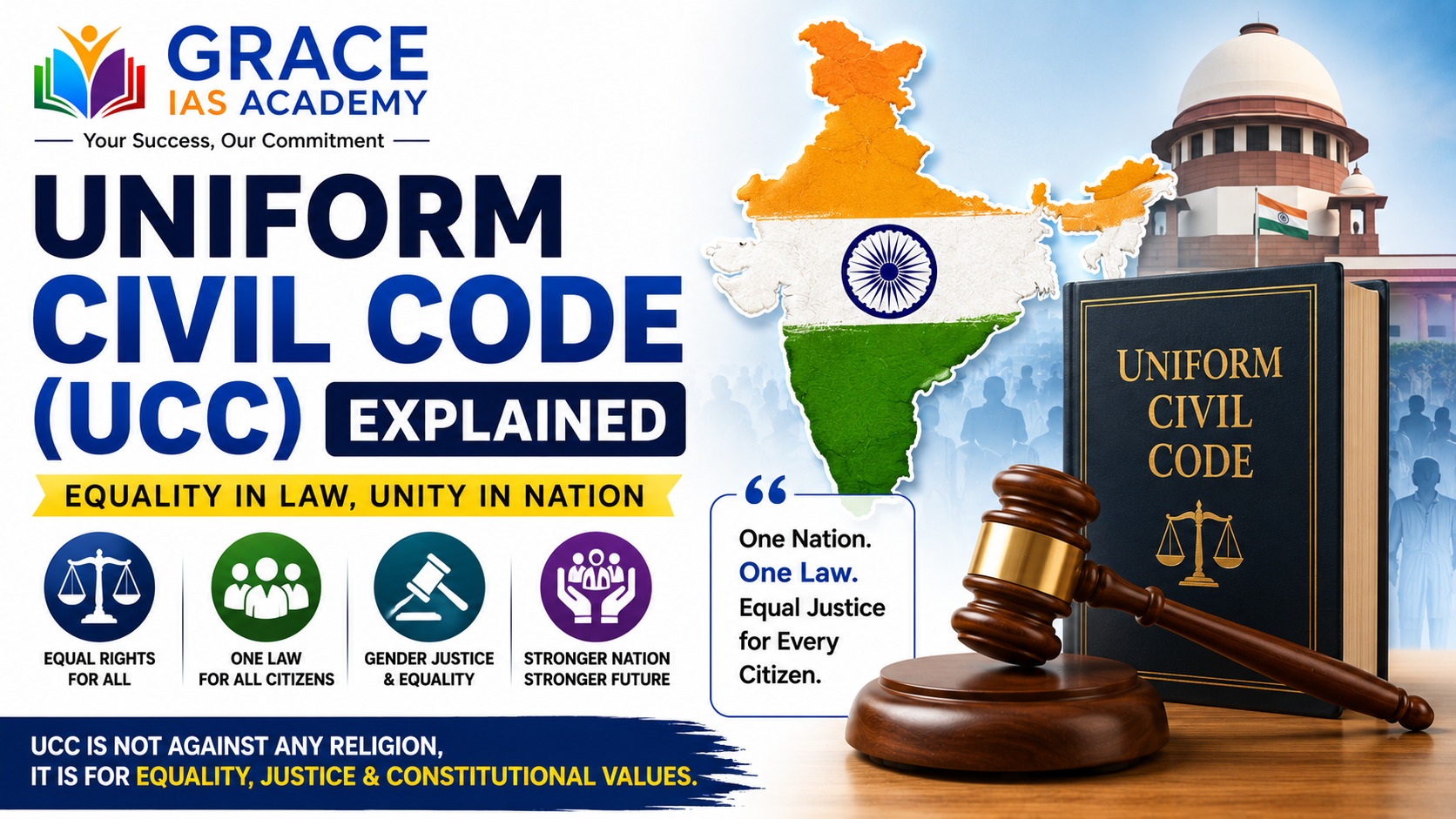
Uniform Civil Code (UCC) Explained: Meaning, Importance, Challenges & Impact
The Uniform Civil Code (UCC) is one of the most debated topics in Indian polity and governance. It has frequently been discussed in courts, legislatures, and public discourse due to its implications for equality, secularism, and personal laws. For UPSC aspirants and citizens alike, understanding the concept of UCC is essential because it lies at the intersection of law, society, and constitutional values.
What is the Uniform Civil Code (UCC)?
A Uniform Civil Code refers to a common set of civil laws that would apply equally to all citizens of India, irrespective of their religion, caste, or community.
It seeks to replace religion-based personal laws governing matters such as:
-
Marriage
-
Divorce
-
Adoption
-
Inheritance
-
Succession
-
Maintenance
Under UCC, all citizens would be governed by the same civil laws in these matters.
Constitutional Basis of UCC
The concept of UCC is mentioned in Article 44 of the Indian Constitution under the Directive Principles of State Policy (DPSP).
Article 44 states:
"The State shall endeavour to secure for the citizens a Uniform Civil Code throughout the territory of India."
Although Directive Principles are not legally enforceable, they serve as important guidelines for governance and policymaking.
Why is UCC Being Discussed?
India follows different personal laws for different religious communities.
Examples include:
-
Hindu Personal Law
-
Muslim Personal Law
-
Christian Personal Law
-
Parsi Personal Law
Supporters of UCC argue that a modern democratic nation should have equal civil laws for all citizens, while opponents emphasize the protection of religious and cultural diversity.
Importance of Uniform Civil Code
Promotes Equality
A common civil code would ensure equal treatment of all citizens regardless of religion.
It supports the constitutional principle of equality before law (Article 14).
Strengthens National Integration
A uniform legal framework can promote a sense of common citizenship and strengthen national unity.
Gender Justice
Many advocates argue that UCC can help eliminate discriminatory practices and promote equal rights for women across communities.
Simplifies Legal System
Multiple personal laws often create complexity and legal confusion. A common code could make civil laws simpler and more uniform.
Challenges in Implementing UCC
Religious Diversity
India is home to diverse religious and cultural traditions. Many communities view personal laws as an integral part of their identity.
Fear of Cultural Erosion
Some groups fear that a common civil code may undermine cultural and religious autonomy.
Political Sensitivity
The issue is politically sensitive and often generates intense public debate.
Need for Consensus
Successful implementation would require extensive consultations with religious groups, legal experts, civil society, and stakeholders.
Supreme Court's View on UCC
Over the years, the Supreme Court has highlighted the importance of a Uniform Civil Code in several judgments.
The Court has often observed that a common civil code could promote national integration and gender equality while reducing legal inconsistencies.
However, it has also emphasized that implementation remains a matter for the legislature and government.
Potential Impact of UCC
If implemented effectively, UCC may lead to:
-
Greater legal uniformity
-
Enhanced gender justice
-
Stronger constitutional equality
-
Simplified civil laws
-
Improved access to justice
At the same time, policymakers would need to ensure that cultural sensitivities and minority rights are respected.
The Uniform Civil Code remains one of the most significant constitutional debates in India. It represents the challenge of balancing equality, secularism, gender justice, and cultural diversity within a democratic framework.