
Latest news
India's Space Economy
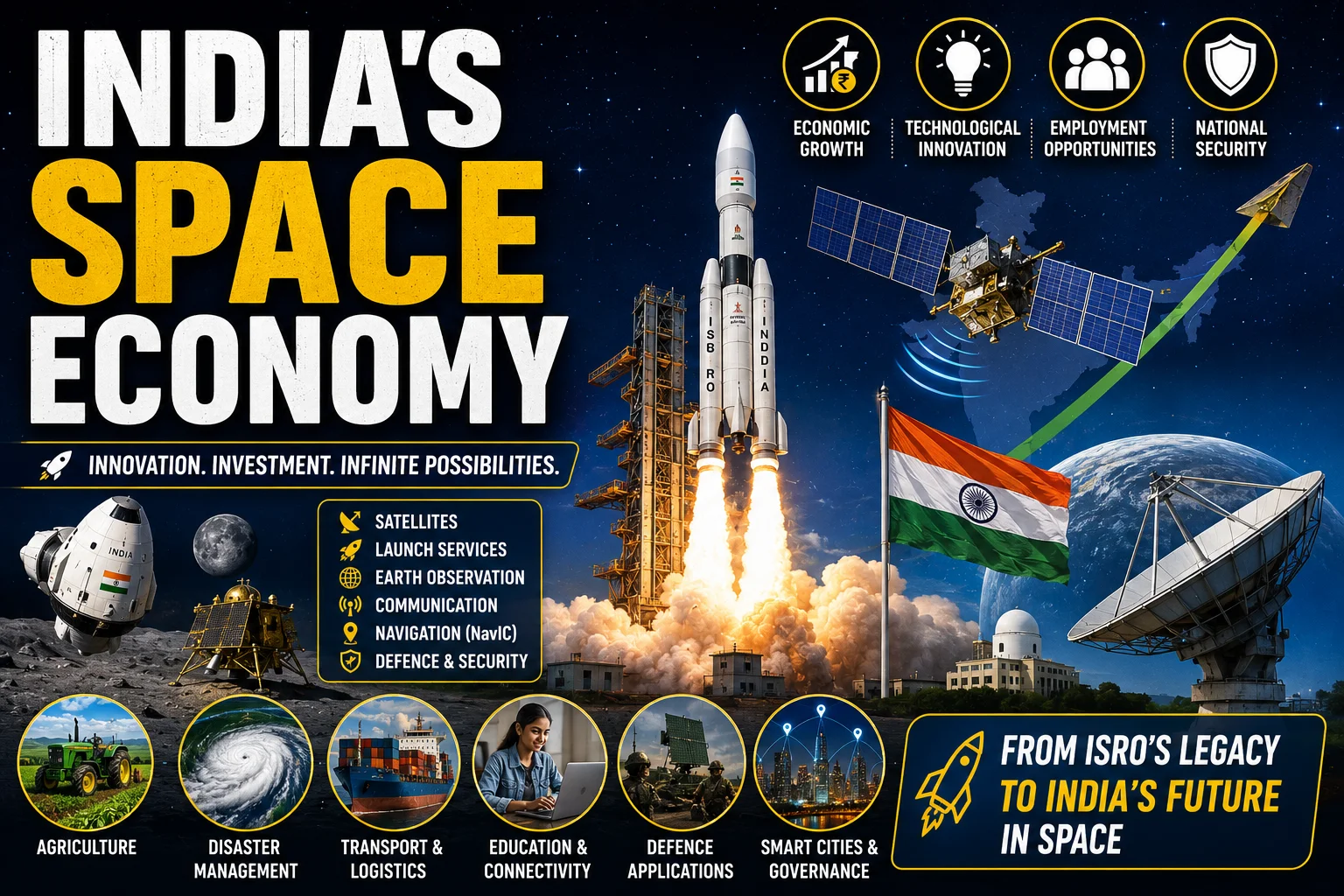
India's Space Economy: Growth, Opportunities & Future Potential
India's space programme has transformed from a modest scientific initiative into one of the world's most dynamic and cost-effective space ecosystems. Over the years, the Indian Space Research Organisation (ISRO) has achieved remarkable milestones through missions like Chandrayaan-3, Aditya-L1, and the upcoming Gaganyaan Mission, earning global recognition for innovation and affordability. Today, India's space sector is evolving beyond government-led research into a thriving commercial ecosystem, creating immense opportunities for economic growth, technological advancement, and employment.
For UPSC aspirants, India's Space Economy is an important topic under Science & Technology, Economy, Governance, and Current Affairs.
What is the Space Economy?
The space economy refers to all economic activities related to the exploration and commercial utilization of outer space. It includes satellite manufacturing, launch vehicles, satellite communication, Earth observation, navigation systems, geospatial services, space-based internet, remote sensing, scientific research, and commercial space applications.
The benefits of the space economy extend beyond the aerospace industry, supporting sectors such as agriculture, healthcare, education, disaster management, transportation, banking, telecommunications, and defence.
Why is India's Space Economy Important?
Space technology has become an integral part of India's development. Satellites provide accurate weather forecasting, disaster warnings, crop monitoring, mineral exploration, fisheries management, and environmental conservation. Navigation systems such as NavIC improve transportation and logistics, while satellite communication strengthens digital connectivity in remote regions.
The growing space sector also attracts foreign investment, encourages innovation, creates high-skilled employment, and boosts India's manufacturing capabilities.
Government Initiatives
Recognizing the sector's potential, the Government of India has introduced several reforms to encourage private participation.
Key initiatives include:
-
Opening the space sector to private companies and startups.
-
Establishment of IN-SPACe (Indian National Space Promotion and Authorization Centre) to facilitate private participation.
-
Strengthening NewSpace India Limited (NSIL) for commercialization of ISRO technologies.
-
Implementation of the Indian Space Policy 2023, providing a clear framework for public-private collaboration.
-
Promotion of startups developing satellites, launch vehicles, and space-based services.
These initiatives aim to make India a global leader in affordable space technology.
Opportunities in India's Space Economy
India offers enormous opportunities in:
-
Satellite manufacturing
-
Commercial launch services
-
Space-based communication
-
Earth observation and remote sensing
-
Geospatial technologies
-
Space tourism
-
Defence and national security
-
Artificial Intelligence and data analytics
-
Private space startups
With increasing global demand for low-cost satellite launches, India is well-positioned to expand its share in the international space market.
Challenges
Despite significant progress, India faces several challenges:
-
High research and development costs.
-
Limited private investment compared to developed countries.
-
Need for advanced manufacturing infrastructure.
-
Shortage of highly skilled professionals.
-
Space debris management.
-
Increasing global competition from established space agencies and private companies.
Future Prospects
India's space economy is expected to witness rapid growth over the coming decade. The expansion of private space companies, increasing commercial satellite launches, advancements in reusable launch vehicles, and growing demand for satellite-based services will further strengthen the sector.
Emerging technologies such as small satellites, reusable rockets, satellite internet, and deep-space exploration present new avenues for economic growth and innovation. By leveraging its engineering talent and cost-effective capabilities, India has the potential to become a global hub for space technology and services.