
Latest news
Deepfake Technology
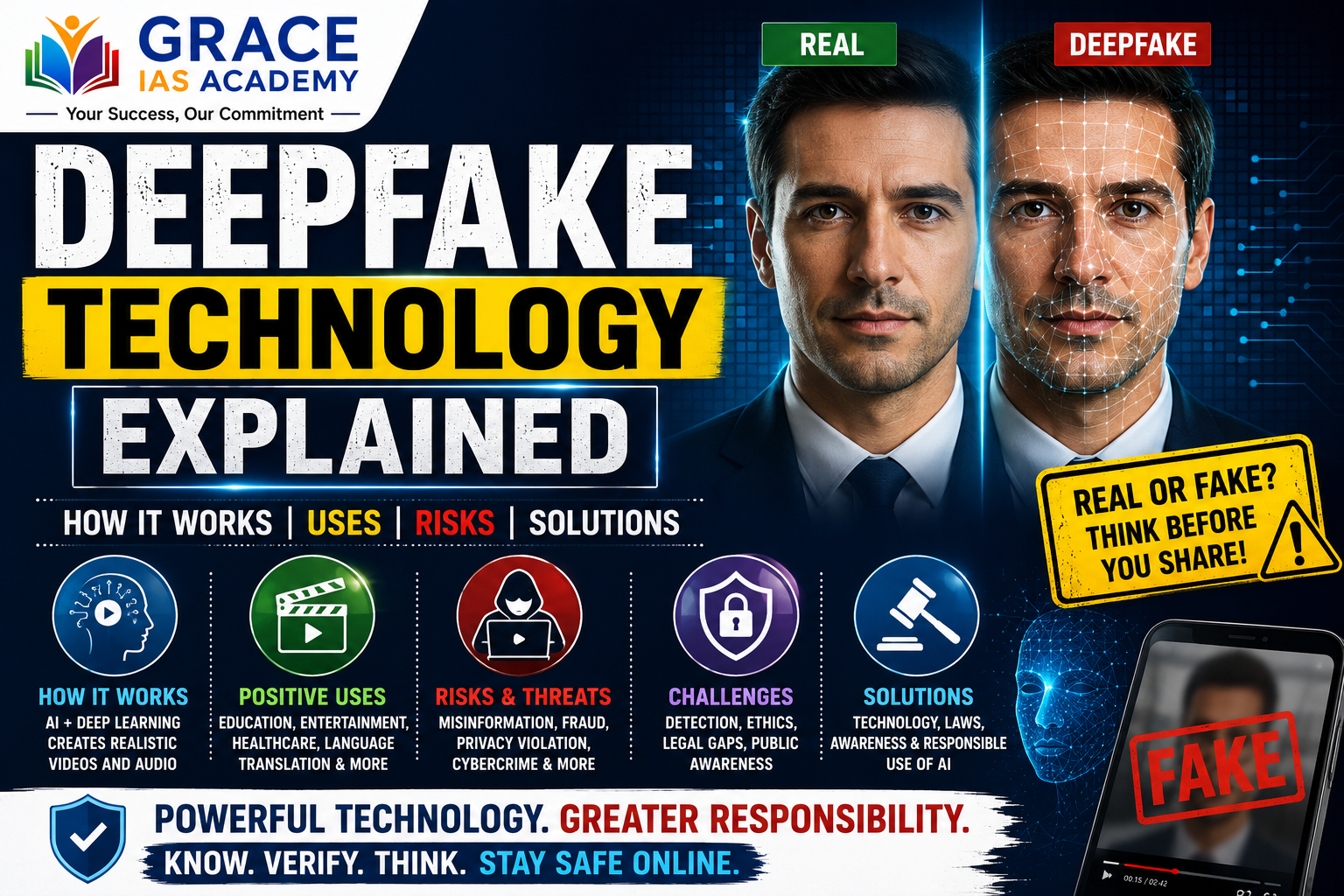
Deepfake Technology Explained: Meaning, Uses, Risks & Challenges
Artificial Intelligence (AI) has revolutionized the digital world, enabling remarkable innovations in communication, entertainment, healthcare, and governance. However, one of its most controversial developments is Deepfake Technology. While deepfakes can be used for creative and educational purposes, they also pose significant risks to privacy, democracy, and cybersecurity. As AI continues to evolve, understanding deepfake technology has become increasingly important for citizens, policymakers, and UPSC aspirants.
What is Deepfake Technology?
A deepfake is an AI-generated image, video, or audio that appears real but has been digitally manipulated to show or make someone say or do something they never actually did.
Deepfakes are created using Artificial Intelligence (AI) and Deep Learning, particularly a technique known as Generative Adversarial Networks (GANs). These systems analyse large amounts of data to replicate a person's facial expressions, voice, and mannerisms with remarkable accuracy.
As a result, it often becomes difficult to distinguish between genuine and manipulated content.
Positive Uses of Deepfake Technology
Although deepfakes are often associated with misinformation, the technology also has several beneficial applications.
Education and Training
Deepfake technology can recreate historical personalities for interactive learning and educational content.
Entertainment Industry
Film producers use AI to de-age actors, recreate historical characters, and produce high-quality visual effects.
Healthcare
AI-generated voices can help patients who have lost the ability to speak due to medical conditions.
Language Translation
Deepfake technology can synchronize lip movements with translated audio, making multilingual communication more natural.
Risks and Challenges
Despite its advantages, deepfake technology presents serious concerns.
Spread of Misinformation
Fake videos and audio can spread false information rapidly through social media, influencing public opinion and creating confusion.
Threat to Democracy
Manipulated political speeches or videos can mislead voters and affect election campaigns.
Cybercrime and Fraud
Fraudsters can use cloned voices or fake videos to impersonate individuals, leading to financial fraud and identity theft.
Privacy Violations
Deepfake technology may be misused to create fake videos without a person's consent, harming their reputation and personal dignity.
National Security
Fake videos involving public officials or military leaders could create panic, diplomatic tensions, or security threats.
Measures to Combat Deepfakes
Governments, technology companies, and researchers are developing solutions to address the growing threat of deepfakes.
Some important measures include:
-
AI-based deepfake detection tools.
-
Stronger cybersecurity frameworks.
-
Public awareness and digital literacy.