
Latest news
Meaning of Anti-Defection Law
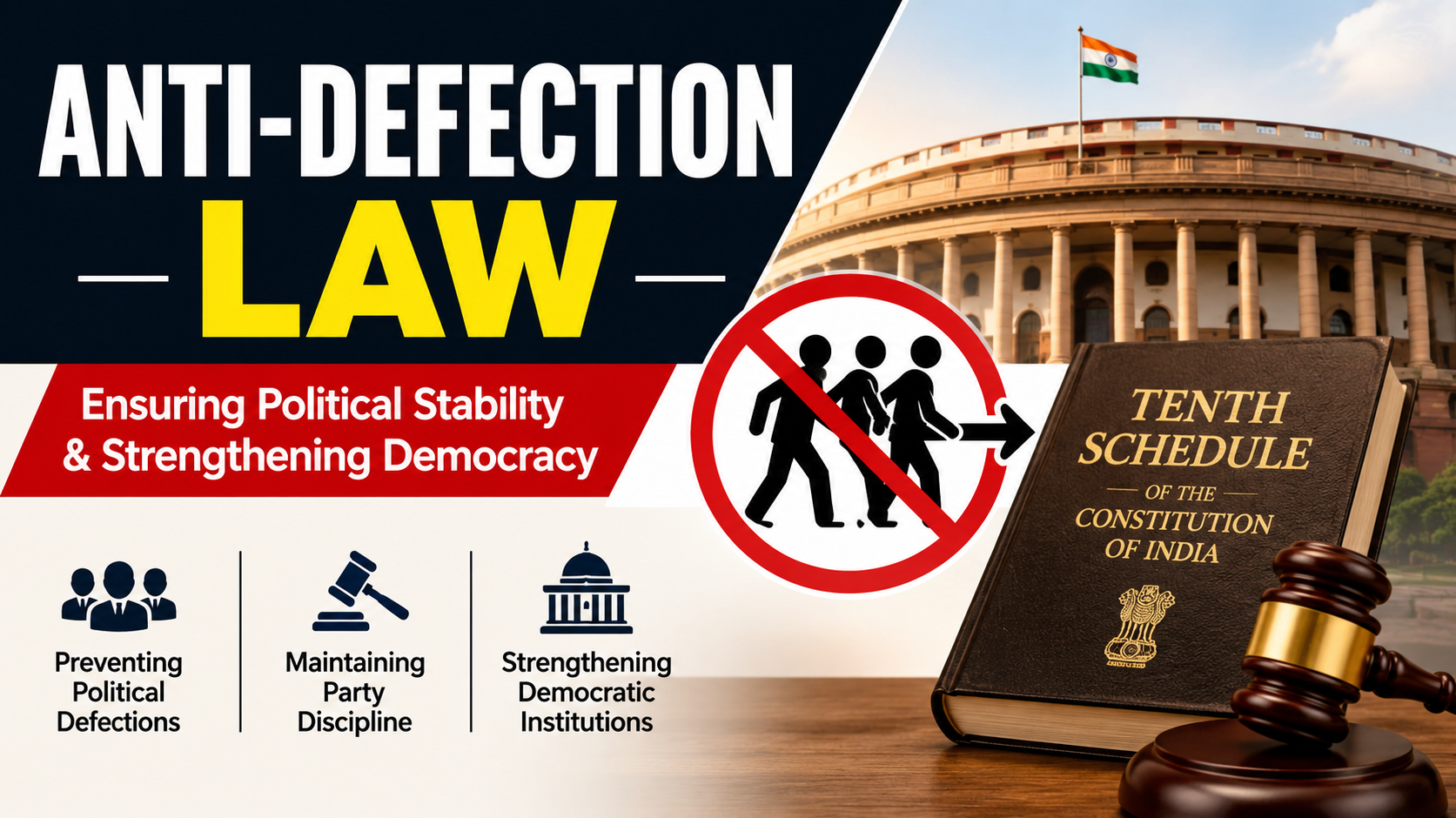
What is the Meaning of Anti-Defection Law?
The Anti-Defection Law was introduced to prevent elected representatives from changing political parties after elections for personal gains, political instability, or ministerial benefits. It aims to maintain political stability and strengthen the democratic process by discouraging unethical political defections.
The Anti-Defection Law was incorporated into the Constitution through the 52nd Constitutional Amendment Act, 1985, which added the Tenth Schedule to the Constitution. It lays down the grounds on which Members of Parliament (MPs) and Members of Legislative Assemblies (MLAs) can be disqualified for defection from their political party.
Under this law, legislators can lose their membership if they voluntarily give up the membership of their political party or vote against the party whip without prior permission. The law acts as a mechanism to maintain party discipline and ensure stable governments.
Any dispute regarding disqualification under the Anti-Defection Law is decided by the Speaker of the Lok Sabha or the Chairman of the Rajya Sabha (or respective state legislative presiding officers). Their decision is subject to judicial review by the courts.
Evolution of the Anti-Defection Law
Before the enactment of the Anti-Defection Law, Indian politics witnessed frequent party switching by legislators, leading to political instability. The phrase “Aaya Ram, Gaya Ram” became famous after an incident in Haryana in 1967 when legislator Gaya Lal changed political parties multiple times in a single day.
To address this growing problem of political defections, Parliament enacted the 52nd Constitutional Amendment Act, 1985, during the government of Prime Minister Rajiv Gandhi. This amendment inserted the Tenth Schedule into the Constitution.
Initially, the law allowed exemptions in cases of party splits if one-third members defected together. However, misuse of this provision led to the 91st Constitutional Amendment Act, 2003, which removed the split provision and strengthened anti-defection measures.
Over time, judicial interpretations by the Supreme Court have clarified the law’s scope and limitations, balancing party discipline with democratic freedoms and constitutional values.
Grounds for Disqualification under Anti-Defection Law
A legislator may be disqualified under the Anti-Defection Law under the following circumstances:
Voluntarily Giving Up Party Membership
A member can be disqualified if they voluntarily resign from their political party. Even without a formal resignation, conduct indicating support for another party may be treated as voluntarily giving up membership.
Voting Against Party Whip
If a legislator votes or abstains from voting in the House against the directions (whip) issued by their political party without prior permission, they may face disqualification.
Independent Members Joining a Party
An independent candidate elected to the House becomes disqualified if they join a political party after the election.
Nominated Members Joining a Party
A nominated member may join a political party within six months of entering the legislature. Joining a party after six months may lead to disqualification.
Exceptions to the Anti-Defection Law
Merger Rule (No Disqualification)
No disqualification occurs when:
✅ A political party merges with another party, and
✅ At least two-thirds of the members of the legislature party agree to the merger.
This provision protects genuine political realignments while discouraging opportunistic defections.
Important Supreme Court Judgments
Kihoto Hollohan Case (1992)
The Supreme Court upheld the constitutional validity of the Anti-Defection Law while ruling that the Speaker’s decision is subject to judicial review. The Court held that democracy requires accountability and fairness in disqualification decisions.
Nabam Rebia Case (2016)
The Supreme Court ruled that the Speaker should not decide disqualification petitions when a motion for their own removal is pending, ensuring neutrality in decision-making.
Maharashtra Political Crisis (2022)
During the political crisis involving the Shiv Sena, questions arose regarding party leadership, the authority of the whip, and disqualification proceedings. The case highlighted practical challenges in implementing the Anti-Defection Law and raised debates regarding internal party democracy.
Criticism of the Anti-Defection Law
Despite its importance, the Anti-Defection Law faces several criticisms:
-
It restricts the freedom of legislators to vote according to their conscience.
-
It strengthens excessive control of political parties over elected representatives.
-
Delays by Speakers in deciding disqualification petitions can influence government stability.
-
It sometimes discourages healthy dissent within political parties.
Need for Reforms in the Anti-Defection Law
Several experts and committees have suggested reforms, including:
-
Limiting the whip only to confidence motions, money bills, and no-confidence motions.
-
Establishing an independent tribunal instead of the Speaker for deciding disqualification cases.
-
Ensuring time-bound decisions on defection petitions.
-
Encouraging internal democracy within political parties.
The Anti-Defection Law was introduced to curb political instability and unethical defections while preserving democratic accountability. It has played a significant role in strengthening party discipline and maintaining stable governments. However, concerns regarding legislative independence, delays in adjudication, and misuse of party whips highlight the need for reforms. A balanced framework that preserves both political stability and democratic debate remains essential for the healthy functioning of India’s parliamentary democracy.