
Organisation
IAS COACHING IN CHANDIGARH
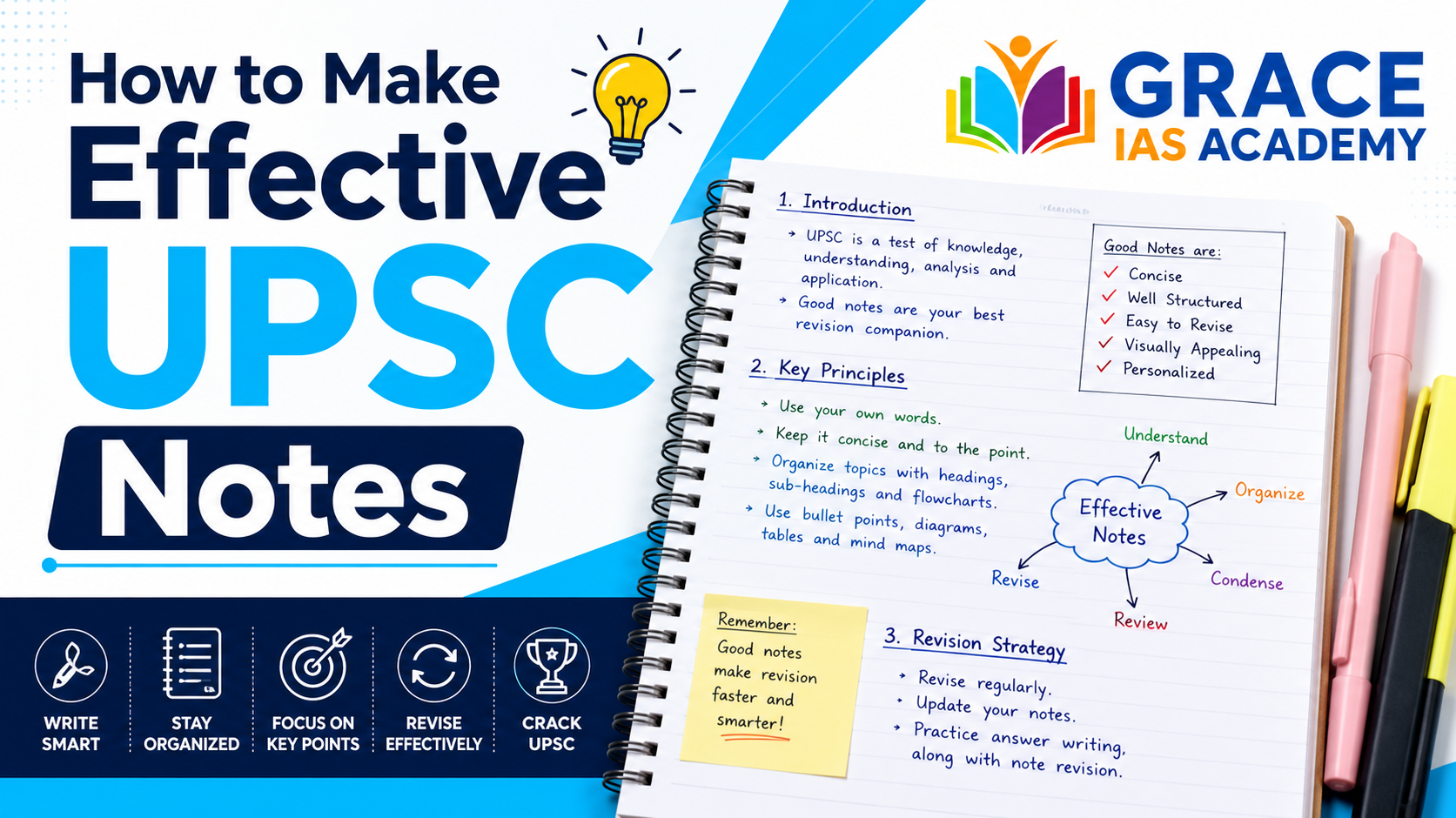
How to Make Effective UPSC Notes: A Practical Approach
One of the biggest mistakes aspirants make is reading extensively but revising very little. Effective note-making helps reduce bulky material into concise, exam-oriented content that can be revised repeatedly in limited time. The purpose of notes is not to rewrite books but to create a personal revision resource.
Begin with the Syllabus
The UPSC syllabus should act as the guiding framework for note preparation. Before starting any subject, divide the syllabus into smaller themes and subtopics. This helps maintain relevance and prevents unnecessary information overload.
For instance, under Polity, topics may include:
- Fundamental Rights
- Parliament
- Judiciary
- Constitutional Bodies
Keeping notes aligned with syllabus keywords ensures focused preparation.
Build Notes in Stages
Stage 1: Conceptual Understanding
The first step is to understand the topic through standard sources. During initial reading, avoid excessive highlighting or copying paragraphs. Focus on understanding concepts and identifying core themes.
At this stage, notes should contain:
- Definitions and concepts
- Important constitutional provisions or facts
- Key features and classifications
- Basic examples wherever necessary
The objective is clarity rather than volume.
Stage 2: Consolidation of Information
After understanding the topic, convert lengthy content into concise and readable points. Information should be organised in a way that enables quick revision.
A good note generally contains:
- Brief introduction
- Core dimensions of the topic
- Important facts or examples
- Relevant constitutional, historical, or economic linkages
- Short concluding takeaway
For example, while preparing notes on Fundamental Rights, one may include constitutional provisions, key features, judicial interpretations, and recent developments related to rights and liberties.
Stage 3: Enrichment for Mains Examination
Advanced preparation requires adding analytical depth. Once basic notes are prepared, enrich them with:
- Committee recommendations
- Supreme Court judgments
- Government reports and indices
- Data and statistics
- Real-life examples and case studies
- Interlinkages with current affairs
Such additions improve answer quality and help in multidimensional thinking during the Mains examination.
Preferred Structure of Notes
A well-structured note is easier to revise and retain. Instead of lengthy paragraphs, concise presentation should be preferred.
Useful methods include:
- Bullet points for factual information
- Tables for comparison-based topics
- Flowcharts for processes and governance themes
- Mind maps for revision purposes
For example, comparison-based themes such as Parliamentary vs Presidential system or Fundamental Rights vs Directive Principles can be effectively prepared using tables.
Keep Notes Concise
Lengthy notes often become difficult to revise before the examination. Ideally, each topic should be reduced to limited pages containing only high-yield information.
The guiding principle should be:
Maximum relevance in minimum space.
The purpose of notes is revision efficiency rather than information collection.
Integrate Current Affairs
Static and dynamic portions of the syllabus should not be treated separately. Whenever a topic appears in current affairs, it should be linked with existing subject notes.
For example:
- Supreme Court judgments can be linked with Polity topics.
- Climate events may be linked with Geography and Environment.
- Government schemes may be connected with Governance and Economy.
This integrated approach improves both Prelims and Mains preparation.
Revision: The Deciding Factor
The effectiveness of notes depends largely on repeated revision. Even the best material becomes ineffective if left unrevised.
A systematic revision cycle may include:
- Immediate revision after completion of a topic
- Weekly revision for reinforcement
- Periodic revision before tests and examinations
Repeated exposure improves recall and answer-writing quality.
Role of Previous Year Questions
Previous Year Questions provide insight into the nature of examination demands. Before finalising notes for any topic, analysing previous trends helps identify recurring themes and areas of emphasis.
This ensures preparation remains examination-oriented rather than purely theoretical.
Conclusion
Effective UPSC notes should be concise, syllabus-oriented, regularly updated, and easy to revise. The emphasis should remain on understanding and repeated revision rather than excessive accumulation of material. Well-made notes gradually become a personalised knowledge base that significantly reduces preparation burden during the final stages of examination.